

Key takeaways
KBA verifies identity through personal questions. Organizations use it to confirm users are who they claim to be by testing knowledge of private information—from preset security questions to real-time queries pulled from financial records.
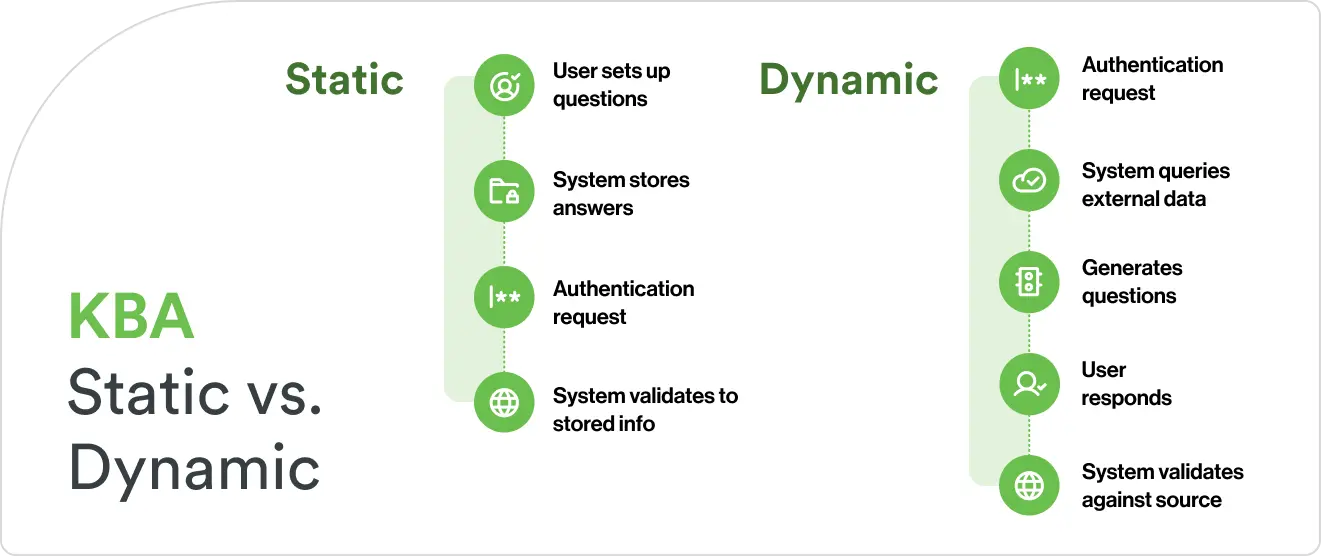
Static and dynamic KBA serve different risk levels. Static KBA relies on questions a user sets in advance. Dynamic KBA generates questions on the fly from external data sources, making it harder to fake but more complex to implement.
KBA works best as part of multilayered security. Personal knowledge is increasingly available through data breaches and social media. Pairing KBA with stronger methods like phishing-resistant multi-factor authentication (MFA) closes these security gaps.
The future of identity verification is moving beyond what you know. Continuous verification, device trust, and adaptive policies are replacing one-time knowledge checks—for both human users and machine identities.
Why does knowledge-based authentication matter in identity security?
Knowledge-based authentication (KBA) gives organizations a way to prove that a user is who they claim to be. When a user attempts to access a resource like an app or database, they typically enter credentials like a username and password. Stronger authentication methods prevent unauthorized access beyond those credentials in case they have been compromised.
Most people have encountered this tried-and-tested method when they forget a password. During the reset process, they answer security questions that only they should know -- such as their first car's color or the name of a childhood pet. Users that give the answers they provided during account set up clears them to proceed with the reset.
KBA in identity verification represents a simple form of multi-factor authentication (MFA). When a user attempts to access a resource, MFA adds additional steps, for further proof of identity.
NIST identifies three types of MFA:
What you know: Answers to personal questions others can't claim (this is KBA)
What you have: Access to a device like a mobile phone or digital key
Who you are: Unique biometric data like face scans, retinal scans, and fingerprints
KBA also matters because it shows up in places many people don't expect. Credit bureaus use it when you request a copy of your credit report. E-signature platforms use it to confirm the person signing a document is the intended signer. The IRS uses it during online identity verification. Recognizing KBA use cases and its limitations helps security teams decide which authentication methods belong in their stack and which ones need reinforcement.
What is KBA verification and how does it work?
KBA verification confirms identity by asking personal questions. The system might pull its "knowledge" from preset security questions or generate them in real time.
Here are the five steps of KBA verification:
1. Identify the user: The user provides basic identifying information, which may include their name, date of birth, or account number—so the system knows whose records to check.
2. Question the user: The system either retrieves questions the user set up earlier (static KBA) or generates new questions from external data sources like credit bureaus or public records (dynamic KBA).
3. The user responds: The user answers three to five questions within a set time limit. This time limit reduces the chances that an unauthorized user could look up answers while the session is open.
4. The system validates: It compares the user's answers against stored records or external data. Most systems require a minimum number of correct answers rather than a perfect score.
5. Authentication: If enough answers match, the user is verified and granted access. If not, the system may lock the account, trigger a secondary verification method, or direct the user to contact support.
The specifics vary by implementation. Financial institutions or healthcare providers, for example, may set different parameters to strengthen the security of sensitive data. But the underlying logic is the same: test the user's knowledge against information the organization already knows.
KBA and identity threats: what the numbers show
Identity attacks are one of the most common paths into an organization. These numbers show why verifying identity correctly matters and why relying on knowledge alone carries risk.
1. Verizon 2025 Data Breach Investigations Report; 2. Bitwarden 2025 World Password Survey; 3. IBM Cost of a Data Breach Report 2025
What is the difference between static KBA and dynamic KBA?
The password-reset example above is one form of KBA, but it's not the only one. The method splits into two variants—static and dynamic—and the difference between them determines how hard it is for an attacker to fake a correct answer.
How does static KBA work?
Static KBA uses questions and answers the user sets up in advance, usually during account registration. The user picks from a list of predetermined questions or writes their own, which the system could draw on for authentication later. Common examples include:
What is your mother's maiden name?
What was the name of your first pet?
What was the make of your first car?
In what city were you born?
What was the name of your elementary school?
The security premise is straightforward: Only the account holder should know these answers. However, the security premise may also be weakened, as many common answers are discoverable on social media and other sources.
Static KBA also puts a burden on users’ memories. People forget the exact answers they entered—Did they capitalize the city name? Or did they use a nickname for the pet? Inconsistent answers lock out legitimate users while doing little to stop a determined attacker.
How does dynamic KBA work?
Dynamic KBA generates questions in real time by pulling data from external sources. These could include credit bureaus, public records databases, and financial transaction histories. These are sometimes called "out-of-wallet" questions because the answers aren't the kind of information a person carries with them or posts online.
Examples of dynamic KBA questions:
Which of these addresses have you lived at in the past five years?
What was the approximate monthly payment on your most recent auto loan?
Which bank holds your current mortgage?
What month and year did you open your checking account?
Because the questions change with every authentication attempt and draw on data that's harder to research, dynamic KBA is more resistant to social engineering, the practice of manipulating people into revealing private information.
Dynamic KBA has its own limitations, however. Outdated records, recent changes to accounts, and limited financial histories can confuse users and the system itself.
Static KBA vs. Dynamic KBA at a glance
Feature | Static KBA | Dynamic KBA |
|---|---|---|
Question source | Pre-set by the user during registration | Generated in real time from credit bureaus, public records, and financial data |
Answer storage | Stored in the organization’s database | Validated against external data. No answers stored locally |
Security level | Lower, answers are researchable through social media and breaches | Higher, answers to out-of-wallet questions are harder to research or guess |
User experience | Familiar and straightforward | Can feel intrusive. Users may not recognize their own financial detail |
Implementation cost | Lower, with no third-party data fees | Higher, requires paid data-source integrations |
Best fit | Low-risk scenarios: account recovery, secondary verification | High-risk scenarios: identity proofing, financial transactions, regulatory compliance |
What are the strengths and weaknesses of KBA?
Knowledge based authentication (KBA) has survived for decades in security workflows because it solves the remote identity verification problem without requiring any special hardware or software on the user's end. But the same qualities that make it practical also make it vulnerable in a world where personal data is widely exposed.
Where KBA still holds value
No hardware dependency. Users don't need a phone, a security key, or a biometric reader. KBA works anywhere the user can type an answer.
Useful as a fallback. When a user loses their phone or can't access their primary authentication method, KBA can serve as a backup verification step within a larger recovery flow.
Scalable remotely. KBA can verify identity without an in-person or live interaction.
Works across every channel. KBA functions over the phone, on the web, and through in-person service desks. This makes it one of the few authentication methods that translates across every support channel an organization runs.
Where KBA falls short
Social engineering vulnerability. Attackers who research a target through social media, public records, or phishing can often answer static KBA questions without compromising a system.
Data breach exposure. When organizations that store KBA answers are breached, those answers become permanently compromised. Unlike a password, you can't change your mother's maiden name.
Limited effectiveness. In high-security contexts, KBA is not sufficient, given its vulnerability outlined above.
User friction from forgotten answers. People forget exactly how they formatted an answer years ago. The resulting lockouts create support tickets and frustration for both the user and the helpdesk team.
Accessibility issues. Individuals with limited financial history or data profiles may struggle with some types of KBA prompts.
Blind spots with non-human identities. KBA is designed for people. It can't verify the identity of a service account, an API key, or an automated workflow. This growing category of machine-to-machine connections now outnumber human users in many organizations. As workloads shift to cloud services and automated pipelines, this gap becomes harder to ignore.
What are some knowledge-based authentication alternatives?
Given the shortcomings of KBA discussed above, many organizations are looking for modern authentication strategies that strengthen security and improve user experience. These alternative methods do both.
What should you consider when evaluating KBA solutions and vendors?
If your organization still relies on KBA, or needs to implement it for regulatory reasons, choose your vendor and configuration carefully to avoid unnecessary risk. Consider these factors when evaluating knowledge-based authentication solutions:
Compliance requirements
Some industries mandate KBA for specific transactions. The IRS requires it for online identity verification. Financial services regulations reference it in customer due-diligence workflows.
Document which frameworks or regulations apply to your organization, like SOC 2, HIPAA, PCI DSS, or others, and confirm that the vendor's implementation meets those standards.Integration with your identity stack
Knowledge-based authentication software should work within your existing identity and access management (IAM) infrastructure, not alongside it. Check whether the solution supports your authentication protocols, whether you use SAML, OAuth, or OpenID Connect, and whether it can function as one factor within a broader MFA strategy rather than a standalone gate.Data source quality
For dynamic KBA, the vendor's data sources determine the quality of the questions. Ask how frequently data is refreshed, what the false-positive and false-negative rates look like, and how the system handles users with thin data profiles.User experience and fallback paths
How many questions does the system require? What happens when a legitimate user fails? A well-designed KBA solution provides graceful fallback options -- like a secondary verification method or a path to support-- rather than a hard lockout.Security posture
Ask how the vendor stores and encrypts KBA data, whether rate limiting and lockout policies are configurable, and what their breach-response track record looks like. If the vendor stores static KBA answers in a database, those answers become a target.Total cost
Dynamic KBA vendors typically charge per authentication because each attempt queries third-party data services. Factor in implementation, maintenance, and support costs alongside per-transaction fees to understand the true total.
These factors treat KBA as one component of a broader identity security strategy rather than a standalone method. With that mentality, you will get more value from your KBA vendor investment while limiting exposure.

What can organizations do to strengthen identity security beyond traditional KBA?
KBA was designed for a world where personal information was hard to find and most access happened from a single office desktop. That world no longer exists. Data breaches have put billions of personal records into circulation, making the answers to security questions trivially easy to look up.
Attackers today use automated credential stuffing, AI-generated phishing, and social engineering techniques sophisticated enough to extract KBA answers directly from victims. All the while, customers expect the same fast, low-friction experiences. Organizations that rely on KBA as a primary verification method are carrying a risk that their threat environment has already outgrown.
To combat that risk, build your organization's authentication strategy on these four principles:
Multi-layered authentication combines multiple factors and methods rather than relying on any single approach. KBA can still play a role—but as one layer within a broader stack, not the foundation.
Risk-based decisions apply the right level of security based on context. A login from a recognized device on a trusted network gets a lighter touch. The same account accessed from an unfamiliar location triggers additional verification.
Phishing-resistant methods use cryptographic proof and hardware-backed authentication like FIDO2 security keys to eliminate the risk of credential interception entirely.
Continuous verification moves beyond one-time authentication to ongoing validation throughout a session. If a device's security posture changes or behavior deviates from established patterns, the system may require re-authentication or revoke access.
User-centric design balances security with experience. The strongest authentication method fails if people work around it. Adoption depends on making the secure path the easiest path.
Modern identity security platforms combine these capabilities in a single solution. Duo integrates phishing-resistant multi-factor authentication, device health verification, single sign-on, and risk-based access policies—replacing the need for standalone KBA while maintaining a user experience that encourages adoption rather than workarounds.
What about non-human identities?
Non-human identities (NHIs), which include service accounts, API keys, machine certificates, and bot credentials, now outnumber human users in many enterprise environments. These identities can't answer security questions, but they still need authentication, authorization, and lifecycle management that KBA methods can't offer. Identity orchestration platforms are emerging to manage both human and NHIs under a unified policy framework, closing a gap that knowledge-based methods were never designed to fill.
How should organizations prepare for the future of identity security?
Identity security is moving away from one-time knowledge checks toward continuous, context-aware decisions that cover every identity type. Automated workloads, service accounts, and API-driven pipelines now outnumber human users in many enterprise environments, and traditional KBA methods were never designed to authenticate them.
Organizations still relying on KBA should build a transition plan around phishing-resistant MFA as the authentication baseline, device trust as a precondition for access, adaptive policies tied to risk signals, and an identity strategy that accounts for NHIs alongside human users.
Duo brings these capabilities together in a single solution, integrating phishing-resistant MFA, device health verification, single sign-on, Duo Directory, and adaptive access policies.