

Key takeaways
Agentic Identity and Access Management (IAM) treats AI agents as distinct, non-human identities (NHI) with their own credentials, scoped permissions, and audit trails—unlike traditional IAM built for static human logins.
Gaps in agent governance create untraceable actions and new paths for lateral movement as agents delegate tasks to sub-agents.
Agentic IAM checks an agent's identity, context, and intent on every action, catching drift or misuse mid-task while alerting IT teams and potentially blocking activity.
Agents authenticate with IAMs using cryptographic credentials instead of passwords, and policy engines evaluate their requests in real time—fast enough to keep up with machine-speed automation.
What is agentic IAM?
Agentic IAM is the security framework that treats autonomous AI agents as distinct, governed non-human identities (NHI) with verifiable credentials, scoped permissions, and auditable lifecycles. It does this through five governing principles:
Verifiable identity
Scoped credentials
Continuous authorization
Context awareness
Auditability
Agentic IAM enforces these principles by matching technical components like policy engines and token services. Traditional IAM was never built to handle identity for AI agents.
An AI agent is an autonomous software system that perceives its environment, makes decisions, and takes actions to reach a specific goal. Unlike a human user, an agent can act, delegate, and change its own behavior without anyone at the keyboard. That difference shows up in four traits:
Autonomy: agents act without direct human control at the moment of action.
Ephemerality: agent identities may exist for minutes or hours, rather than years.
Delegation: agents frequently spawn sub-agents or chain tool calls.
Scale: organizations may deploy hundreds or thousands of agents simultaneously.
How does traditional IAM fall short with autonomous agents?
Traditional IAM was built for a slower, steadier identity—someone (a human, device, or application, for example) that logs in once and keeps roughly the same permissions all day. An agent may authenticate dozens of times an hour, needing different permissions for each task it runs. That mismatch is structural, not incidental.
Traditional IAM assumes a person is performing actions and overseeing tool use and activity. It also assumes access needs change slowly enough for periodic reviews to catch problems. Agents break both assumptions at once.
Traditional IAM assumption | Why it fails for AI agents | Agentic IAM approach |
|---|---|---|
Static role assignment | Agents need different permissions for each task | Dynamic, context-aware authorization |
Session-based trust | Agents may operate for seconds or months | Continuous verification per action |
Human accountability | No human present during agent actions | Agent-to-human traceability mapping |
Credential longevity | Long-lived passwords or tokens | Short-lived, cryptographically bound tokens |
What security risks does agentic IAM mitigate?
Without agent governance, AI agents become high-value attack vectors in their own right. Three elevated risks stand out because traditional IAM lacks mechanisms to catch any of them.
Lack of agent accountability
When agents share credentials, security teams cannot tell which agent, version, or delegated sub-agent is responsible for out-of-scope behavior. In 2026, 53% of organizations surveyed had an agent exceed its intended permissions.
Lateral movement by delegated agents
Lateral movement is an attacker's ability to move from one compromised system into others within the same environment. Agent delegation creates new paths for this vector. For example, if Agent A delegates to Agent B, which delegates to Agent C, and the chain doesn't enforce least-privilege agent access, Agent C can end up holding more trust than anyone intended.
Undetected behavior drift
Behavior drift is a change in an agent's actions over time and can be caused by a model update, configuration change, or shift in its environment. Traditional IAM never notices, since it only checks identity once at login, but agentic IAM keeps watching behavior for as long as the agent stays active.
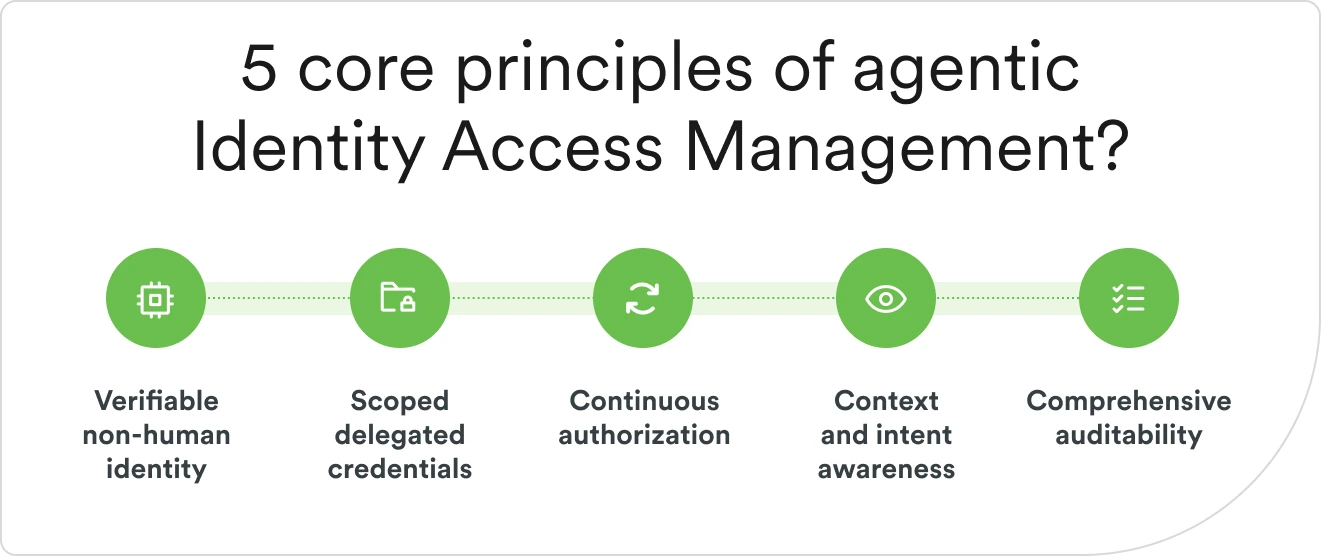
What are the core principles of agentic IAM?
Five principles define how agentic IAM secures autonomous agents.
Verifiable non-human identity
Security teams assign each agent a unique, cryptographically-verifiable identity instead of a shared credential or a borrowed human login. That identity can carry claims about the agent's code version, model version, and intended purpose. Verifiable identity for AI agents makes agent accountability and impersonation prevention possible.
Scoped delegated credentials
When an agent acts on behalf of a user or another agent, it should receive a scoped, time-limited token. Scoped tokens enforce least-privilege agent access by limiting each one to specific resources, specific actions, and a specific window of time. An agent that schedules meetings, for example, gets a token that can create calendar events and nothing else.
Continuous authorization
Agentic IAM evaluates trust at every action instead of only at login, shifting from "authenticate once, trust continuously" to "verify continuously." That shift, the core of zero trust for agents, matters because agents can change context, escalate privileges, or start behaving strangely mid-session. Continuous authorization checks identity, context, intent, and risk on every single action.
Context and intent awareness
Agentic IAM looks at an agent's attempted actions—as well as the data it accesses—and compares these activities to its declared purpose. Context includes factors like the resource being accessed, the time of the request, and the sensitivity of the data involved. For example, an agent requesting database access at 3:00 a.m. with an unfamiliar query pattern can get flagged even when its credentials check out.
Comprehensive auditability
Agentic IAMs log every agent action with full provenance:
Which agent performed it
Which version of that agent was active
Which delegated authority it was acting under
Which policy allowed the action
That record must extend across delegation chains, so if Agent A delegates to Agent B, the audit trail shows both. The result functions like a chain of custody for legal evidence, extending agent accountability across every handoff.
What components secure AI agents?
Six technical components put those principles into practice.
Agent discovery and registration
Development teams often deploy AI agents ad hoc, so organizations first need to find every agent already running in their environment. Registration logs each discovered agent against its verifiable identity and records its purpose, owner, and required permissions. Because agents are ephemeral, this discovery process repeats on an ongoing basis.
Strong agent authentication
Instead of passwords, agents authenticate with cryptographic methods like mutual TLS (mTLS), signed assertions, or attested identities. mTLS means both the agent and the service it's accessing verify each other's certificates before any exchange happens. Cryptographic authentication can't be phished, guessed, or easily stolen the way a password can.
Runtime policy engine
A policy engine implements continuous authorization by evaluating every agent request in real time. Its policies weigh attributes like the agent's identity, the resource being requested, and the surrounding environment. A policy might read: agent X can query customer database Y only during business hours and only for customers in region Z.
Delegated token service
A token service issues the scoped, time-limited tokens that scoped delegated credentials depend on. When an agent requests one, the service checks it against policy, then issues a credential that's limited to a specific scope, expires quickly, and can be revoked at any time. Standards like OAuth 2.0 token exchange or SPIFFE/SPIRE support this kind of workload identity.
Monitoring and telemetry pipeline
Agentic IAM continuously monitors what an agent accesses, how often, and what patterns emerge over time. Those signals feed both real-time alerts and historical analysis. That same monitoring is what makes behavior drift detection and incident response actually work.
Lifecycle governance workflows
Agents move through a lifecycle:
Creation
Active use
Updates
Retirement
Agent governance workflows handle periodic permission reviews, automated revocation when an agent retires, and re-certification when one gets updated. That process prevents "zombie" agents and permission creep while keeping every agent mapped to a responsible human owner.
How does Cisco Duo support agentic IAM controls?
The components described above aren't unique to agentic IAM. They're extensions of identity security capabilities organizations already run for their human users—just applied to identity for AI agents. Cisco Duo is one example of an identity platform built on those same underlying controls, including phishing-resistant multi-factor authentication (Duo MFA) and single sign-on (Duo SSO).
Ready to explore what that looks like for your own agent environment? Start a free trial.