

Key takeaways
ITDR catches attackers who already have valid credentials. Endpoint and network tools were built to spot malware and intrusions. ITDR spots legitimate-looking logins, privilege changes, and access patterns that indicate a compromised account.
ITDR is not a replacement for IAM, EDR, XDR, or SIEM. Each tool serves a different purpose. IAM controls who gets access. EDR monitors endpoints. XDR correlates across layers. SIEM aggregates logs. ITDR specializes in identity-specific attacks that the others were not designed to catch.
The category exists because attackers changed strategy. Credential abuse is now the leading initial access vector in major breach reports. ITDR closes the gap between the moment a credential is stolen and the moment the attacker reaches something valuable.
ITDR is moving toward continuous, context-aware decisions. Next generation solutions cover non-human identities like service accounts, API keys, and agentic AI integrates with zero trust policies and apply machine learning to behavioral baselines for human and machine accounts alike.
Why does ITDR matter in cybersecurity?
ITDR matters because compromised identity, such as stolen login credentials, is the leading access vector in breaches. Meanwhile, legacy security tools were not built to detect or stop attacks that masquerade as legitimate users.
What does ITDR look like in practice?
Consider Priya, a financial analyst at a mid-size healthcare company. Her organization uses an identity provider, a VPN, and endpoint detection on every laptop. The identity provider stores her identifying information (role, access permissions, and login credentials), the VPN encrypts her connections, and the endpoint detection scans for malware. Why doesn't this secure her access?
One morning, an attacker buys Priya's corporate email and password from a dark web marketplace. The credentials came from an infostealer infection on her personal laptop months ago.
The attacker logs in from a different city using a clean browser. The VPN accepts the credentials. The endpoint detection tool sees nothing wrong because there is no malware on the attacker's machine. The firewall lets the traffic through because it is a normal HTTPS session. From the perspective of every existing tool, this is Priya starting her day. However, it is anything but normal. It’s an attack in progress.
How does an ITDR solution stop identity-based attacks?
An ITDR solution looks for other factors. It notices the login is from a city Priya has never worked from, on a device she has never used, and it occurs at 2:00 AM local time. It flags the session, prompts for a multi-factor authentication (MFA), and alerts the security team. If the attacker cannot provide the second factor, the session ends. If they somehow can, the system continues watching and can revoke access the moment the attacker's behavior diverges from Priya's baseline of normal behavior.
Can ITDR solutions monitor non-human activity?
ITDR solutions can also monitor non-human identities like service accounts or automated workflows, including AI agents and automations, and other identities that access applications and resources within an organization. Through the same baseline monitoring, an ITDR can catch attacks that compromise non-human identities by injecting code that alters their instructions—often to exfiltrate data to the attackers.
Several forces have made this kind of attack the default path into organizations:
Distributed workforces. Remote and hybrid work moved authentication off corporate networks. A login from a home connection looks legitimate by default.
Cloud and SaaS adoption. Identity is now the only consistent control plane across cloud platforms, SaaS applications, and on-premises systems. A compromised identity reaches further than a compromised network device.
Credential exposure at scale. Breach databases, infostealer malware, and phishing kits have made valid usernames and passwords available to attackers as commodities.
Regulatory pressure. Frameworks like SOC 2, HIPAA, PCI DSS, and zero trust architecture guidance all push organizations toward continuous monitoring of identity activity.
What is the scale of identity-based attacks?
The trend is not slowing down. These numbers show why understanding ITDR has become a priority for security teams.
1. Verizon 2025 Data Breach Investigations Report; 2. Microsoft Digital Defense Report 2025; 3. IBM Cost of a Data Breach Report 2025.
How does ITDR work?
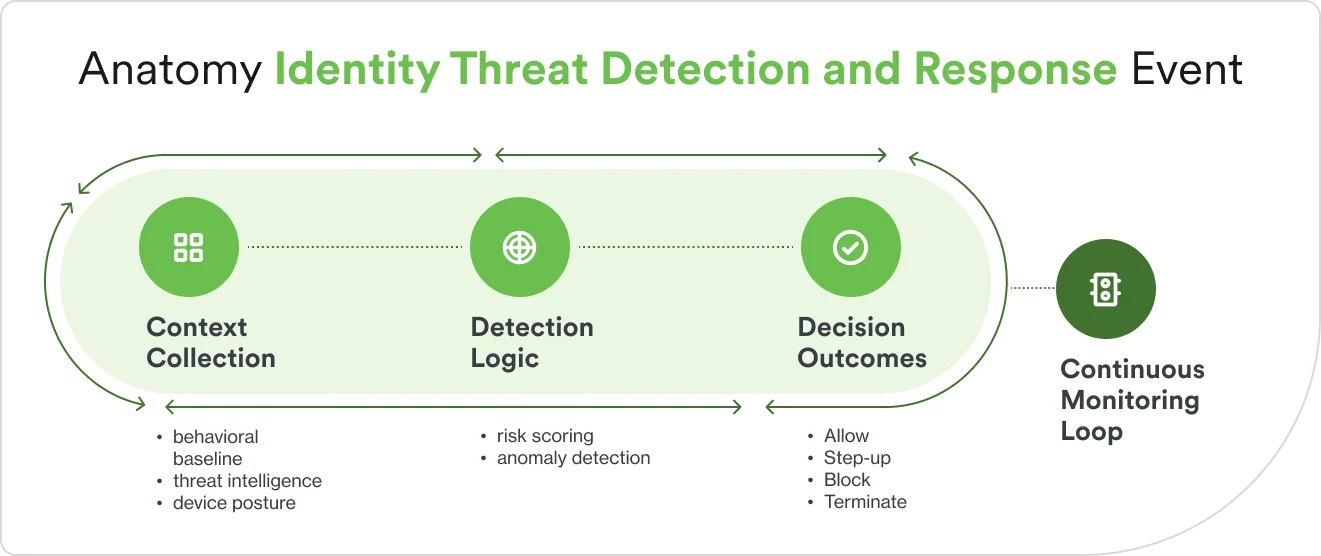
ITDR solutions combine continuous monitoring, behavioral analysis, threat intelligence, and automated response. They collect identity events from every system that issues or checks credentials, compare what is happening to what normally happens for that user or service, and act when the gap indicates compromise.
This activity breaks down into three parallel tasks: monitoring, detection, and response.
1. Continuous monitoring and behavioral analysis
ITDR security tools collect signals from the systems where identities live: directories, identity providers, single sign-on platforms, privileged access tools, and cloud services. That data feeds behavioral analytics, sometimes called user and entity behavior analytics (UEBA).
UEBA builds a profile for each identity:
For Priya, the system learns that she logs in from two locations (home and office), uses a managed MacBook, accesses financial reporting tools between 8:00 AM and 6:00 PM on weekdays, and never touches the engineering wiki.
For a non-human database service account, the system learns that it runs queries against the claims database every 15 minutes but never on weekends or from an IP outside the data center.
Signals the system monitors include:
Login times, source IP addresses, and device fingerprints.
Access to sensitive resources like file shares, databases, and admin consoles.
Privilege usage and elevation requests.
Authentication methods, including which MFA factors were used.
Threat intelligence runs alongside behavioral analytics. It compares activity in the environment against known-bad patterns, such as databases of compromised credentials from public breaches, attacker techniques documented in MITRE ATT&CK (a public catalog of tactics used by real adversaries), and indicators specific to identity attacks. When a login uses a password that already appears in a breach dump, the system raises the priority of that event.
2. Identity threat detection
Detection logic decides which of these signals matter. It combines machine learning models with rules tuned to the identity domain.
In Priya's situation, the system sees a login from a new city at 2:00 AM. That alone scores as a medium-risk anomaly. Then the attacker browses to the HR benefits portal, something Priya accesses once a year during open enrollment, elevating the score higher. Next, the attacker requests access to an administrator group in Active Directory, something Priya has never done.
This crosses the organization's risk threshold and the ITDR blocks the session.
Common detections include:
Suspicious login patterns. Impossible travel (logins from two distant locations within a short window), authentication outside normal hours, multiple failed attempts followed by a success, or logins from unregistered devices.
Privilege escalation. Unexpected changes to group memberships or permissions, attempts to reach privileged accounts like a domain administrator, or use of credential-dumping tools. Specific techniques include Kerberoasting (extracting service-account credentials from Active Directory) and pass-the-hash (reusing a stolen password hash without knowing the actual password).
Lateral movement. An attacker using one compromised account to reach systems that account would not normally touch. This might include a marketing user accessing financial databases, a workstation querying a domain controller, or stolen credentials appearing across unrelated resources in quick succession.
Many ITDR solutions also include identity security posture management (ISPM). ISPM is the proactive side: finding identity weaknesses before attackers exploit them. It searches for:
Dormant accounts that should have been disabled.
Service accounts with more permissions than they need.
User accounts missing MFA.
ISPM reduces the attack surface. ITDR catches the attacks that manage to get through.
3. Automated response and remediation
Detection without response just generates alerts. ITDR solutions act in seconds.
In Priya's scenario, the system has already required a second factor at login. When the attacker requests admin-group access, the system does not wait for a human to review the alert. It terminates the session, disables the account temporarily, and opens an incident for the security team with full context into what was detected, which signals contributed, and what actions were taken.
Common automated responses include:
Session termination. Ending the suspicious session immediately and forcing re-authentication.
Account isolation. Temporarily disabling the account while a human reviews.
Step-up authentication. Requiring an additional factor before allowing the activity to continue.
Credential rotation. Forcing a password reset and revoking active tokens for the affected identity.
Alert escalation. Notifying the security operations team with the full detection context.
Most ITDR tools integrate with security orchestration, automation, and response (SOAR) platforms. SOAR runs predefined playbooks across multiple tools. A confirmed account takeover might trigger workflows that quarantine the affected endpoint, open an incident ticket, and notify the user's manager—all without waiting for a human analyst.
How does ITDR compare with IAM, EDR, XDR, and SIEM?
Identity threat detection and response (ITDR) is one of several security categories that overlap in modern stacks. Each plays its own role in securing access, and ITDR fills a gap the others leave open.
Solution | Area of Focus | How it relates to ITDR |
|---|---|---|
Identity and Access Management (IAM) | Provisioning, authentication, and access policies. Decides who can access what. | IAM is the foundation ITDR protects. IAM grants access. ITDR watches how that access is used and flags misuse. |
Endpoint Detection and Response (EDR) | Threats on individual devices: malware, suspicious processes, file-level activity. | EDR watches the device. ITDR watches the identity. An attacker using stolen credentials from a clean device evades EDR but is visible to ITDR. |
Extended Detection and Response (XDR) | Correlated detection across endpoints, network, cloud, and email. | XDR is the wider net. ITDR is identity-specific depth. Many XDR platforms now include ITDR modules or integrate with dedicated ITDR tools. |
Security Information and Event Management (SIEM) | Log aggregation and correlation. Long-term storage, compliance reporting, and search. | SIEM is the data layer. ITDR is the active protection layer. ITDR feeds identity-specific findings to SIEM for retention and audit. |
Some solutions overlap in ways that deserve further clarification.
IAM versus ITDR
IAM is preventive. It sets access rules before threats appear. ITDR detects based on these rules and responds appropriately. It watches for misuse of access already granted.
EDR versus ITDR
EDR catches attackers who land malware on a device. ITDR catches attackers who do not need malware because they have valid credentials.
Reviewing these distinctions in practice
In Priya's scenario, her endpoint detection tool saw nothing wrong because the attacker's machine had no malware. Her IAM system authenticated the credentials successfully because they were correct. Only ITDR flagged the session, because the behavioral pattern did not match.
What are the common challenges and best practices for ITDR implementation?
Deploying ITDR involves three predictable challenges. Each has a corresponding best practice.
1. Identifying overprivileged accounts
Most organizations carry years of accumulated permissions. Accounts retain rights from projects that ended long ago. Service accounts created for vendors that no longer exist still have active credentials. Users who changed roles kept their old access. This is called permission creep.
Before tuning detection rules, audit what exists:
Inventory current permissions. Document which accounts access which systems, especially privileged ones.
Map permissions to current roles. Confirm that each account's access matches the job it serves today.
Disable dormant accounts. Inactive users still represent credentials an attacker can use.
Audit non-human identities. Service accounts, API tokens, and bot credentials often hold more permissions than any human user.
Enforce least privilege. Reduce permissions to the minimum each account needs. Re-audit regularly.
ITDR solutions can automate large parts of this discovery while the prioritization decisions remain with the security team.
2. Reducing alert fatigue
Alert fatigue is the desensitization that happens when security analysts receive too many alerts to investigate. Identity monitoring is especially prone to noise because users do unusual things for legitimate reasons. For example, traveling executives and contractors with irregular schedules may log in late and from unpredictable locations, or automated processes may operate around the clock.
Strategies that keep alerts useful:
Allow time for baselines to mature. Most behavioral analytics models need two to four weeks of normal activity before they can reliably flag anomalies.
Use risk scoring instead of binary alerts. Score events on a continuum, so analysts focus on what matters.
Whitelist known exceptions. Executives who travel, contractors with unusual schedules, and service accounts with quirky patterns should be explicitly recognized.
Require multi-signal correlation. A single anomaly might be noise. Three correlated anomalies in quick succession is almost certainly a threat.
Automate low-risk responses. Prompting for step-up authentication does not need a human in the loop.
3. Integrating with existing infrastructure
ITDR works only as well as the data it can see. In hybrid environments with on-premises directories, cloud identity providers, and SaaS applications, coverage gaps create blind spots.
Identity provider compatibility. Confirm support for the directories and IdPs already in use—such as Active Directory, Duo Directory, Microsoft Entra ID, Okta, and Google Workspace.
Directory coverage. On-premises Active Directory, LDAP, and cloud-native directories each produce different telemetry. The ITDR tool needs to normalize all of them.
SIEM and SOAR integration. Bidirectional integration matters. ITDR sends findings out and accepts response triggers from existing workflows.
API access. Programmatic access lets the security team build custom playbooks and reports.
Deployment model. Agent-based versus agentless approaches have different coverage and overhead trade-offs.
Start with the systems most attractive to attackers: the identity provider, privileged access systems, and the primary directory. Expand from there.
What should I look for when evaluating ITDR vendors and solutions?
The ITDR market has grown quickly. Evaluate these four areas:
Coverage and visibility
Your ITDR solution should cover the environments you manage and the identity systems you use. It should also be capable of seeing and monitoring the different types of identities—human and non-human—across your systems, and reaching anywhere they are used.
Detection capabilities
The solution should detect specific, documented attack techniques, not just generic anomalies. Ask which identity-specific attacks it covers, such as Kerberoasting, credential stuffing, and token theft. Ask how the behavioral analytics models are trained, how false positives are measured, and whether those numbers come from independent testing or the vendor's own benchmarks.
Response and remediation
Choose a vendor that offers a range of automated responses—from low-impact actions like prompting for a second factor to high-impact actions like disabling an account. It should integrate with your existing SIEM, SOAR, or XDR platform, so response workflows extend beyond identity systems alone.
Usability and operations
Your organization should realize value within weeks, not months. Ask how many staff it requires to operate, whether it needs specialized identity-security expertise, and what the reporting looks like for both technical teams and executives.
One question ties the evaluation together: does the tool work alongside existing MFA, single sign-on, and privileged access management investments, or does it expect to replace them? ITDR vendors that complement existing infrastructure deliver value faster than those that compete with it.

Where does ITDR fit into future cybersecurity strategies?
Several shifts are reshaping what ITDR tools cover and which identities they protect.
Zero trust integration
Zero trust architecture operates on the principle that no user or device should be trusted by default, even inside the network. ITDR provides the live risk signal that makes zero trust practical. Instead of granting access once at login and assuming the session stays safe, a zero trust system asks ITDR what the identity is doing right now. If the risk score rises mid-session, the system can revoke access without waiting for the next login.
How does AI impact the future of ITDR?
AI in ITDR means two specific technologies.
Machine learning for behavioral baselines is in place today. ML models learn what normal behavior looks like for each user and service account, so it can flag deviations. These systems handle the volume of identity events that no human team could review. They also generate false positives, require retraining when work patterns shift, and do not always explain their decisions clearly.
ITDR can both use and defend against generative AI technologies.
Some security vendors use generative AI to summarize incident timelines for analysts, draft response playbooks, and identify novel attack patterns across customers.
On the other side, attackers use generative AI to craft convincing phishing messages, clone voices, and produce deepfake videos. ITDR spots these compromised accounts when their behaviors deviate.
Generative AI also accelerates vulnerability discovery. Attackers can use large language models to scan code for exploitable weaknesses which they could use to compromise non-human identities, making ITDRs a valuable tool for identifying unusual behavior.
When evaluating a vendor's AI capabilities, ask which techniques are in production today, what the false-positive rate looks like in independent testing, and how models are retrained over time.
Passwordless authentication
As organizations move toward FIDO2 security keys (physical devices that use cryptographic proof of identity) and passkeys, ITDR's job shifts. There are no passwords to steal in a true passwordless environment. But tokens, session cookies, and biometric factors remain targets. Adversary-in-the-middle phishing kits can steal session tokens after a legitimate MFA prompt, defeating MFA without having to bypass it. ITDR adapts by monitoring post-authentication signals—such as token reuse from unexpected locations, session anomalies, and privilege changes that indicate the credential was real but the user behind it was not.
Non-human identities
Non-human identities have the security profile of an administrator account with none of the oversight. They do not change passwords. They do not enroll in MFA. They keep running long after the project that created them shuts down. Modern ITDR solutions extend coverage by building behavioral baselines for service accounts, watching for API key reuse from unexpected sources, and flagging credentials that suddenly become more active or more privileged.
Identity orchestration platforms are emerging to unify human and non-human identity management under a single policy framework. Cisco Duo's directory capabilities help organizations manage identity lifecycle and access policies across both types, closing the gap that legacy tools were not designed to fill.
How can I strengthen my company's identity security using ITDR?
Effective identity security combines strong authentication, continuous verification, and rapid response. Those are the same three functions ITDR coordinates. Cisco Duo supports those functions across every layer:
Phishing-resistant MFA provides the strong identity verification that ITDR policies depend on.
Device health checks contribute critical context signals about device posture and trust level.
Adaptive authentication adjusts security requirements based on risk context across location, device, and behavior.
Single sign-on (SSO) with policy-based access controls enables granular, context-aware access decisions across applications.
Identity intelligence provides behavioral analytics and risk scoring to inform detection and response.
Connections to existing identity providers through standard connectors
,reduces deployment time and disruption.
Duo balances security with usability. It steps up security when the context demands it and minimizes friction when the context does not.
Ready to strengthen your identity security with phishing-resistant MFA, device health checks, and SSO? Start a Duo free trial today.