
Why single-IdP dependency is your biggest identity risk

Following the adoption of zero-trust architectures, identity systems have become the new first line of defense. The shift from trusting connections based on network origin to verifying identity and device posture before granting access has been one of cybersecurity's most significant advances.
If your organization relies on a single Identity Provider for every authentication decision, now is the time to evaluate whether that dependency creates more risk than you realize. Cisco Duo offers a free 30-day trial that lets you explore how Duo Single Sign-On (SSO) and Duo Multi-Factor Authentication (MFA) work as a second identity layer alongside your existing infrastructure.
How SSO federation creates a single point of failure
Modern hybrid and multi-cloud adoption typically results in a sprawl of disparate identity systems. The common approach to bridge these silos is through identity federation. Software as a Service (SaaS), Infrastructure as a Service (IaaS), and private applications are redirected to a central Single Sign-On (SSO) system using Security Assertion Markup Language (SAML) or OpenID Connect (OIDC).
This approach delivers real benefits. Security administrators manage one Identity Provider (IdP), which simplifies configuration for Multi-Factor Authentication (MFA), joiner-mover-leaver processes, conditional access policies, and group memberships. Users benefit from not having to remember different credentials for every system they access.
The result is one of the rare occasions where stronger security also delivered a better user experience.
However, this consolidation has a side effect. Most organizations now depend on a single Identity as a Service (IDaaS) provider, usually determined by whichever collaboration suite the organization adopted. That single IdP has become the authentication core for every application, every user, and every access decision.
The four dimensions of IdP concentration risk
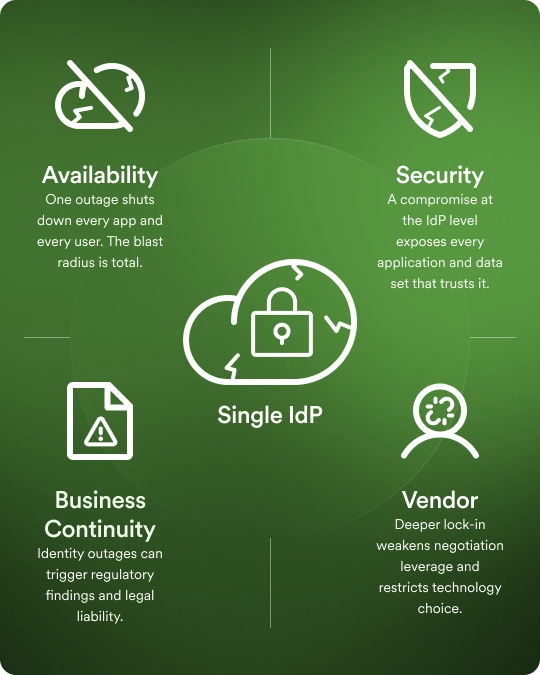
Having a unified identity system creates what risk professionals call concentration risk: a single point of failure in a critical layer. This risk has four distinct dimensions, and each one can affect your organization differently.
Availability risk measures the scope of impact when outages or incidents occur. IDaaS depend on a complex chain of globally shared components, including cloud infrastructure, Border Gateway Protocol (BGP) networks, Domain Name System (DNS), and internal application services. A faulty global configuration change in any one of these components can disrupt the entire downstream IDaaS service. If your organization depends on a single IDaaS provider for all authentication, the blast radius of an outage extends to every application and every user. Consider a scenario where your IdP experiences a four-hour outage during peak business hours. Every employee across every office loses access to every federated application simultaneously. Help desk tickets spike, productivity stops, and revenue-generating activities halt.
Security risk reflects the impact of a systemic compromise. IDaaS providers are mega technology vendors and gatekeepers of large cloud systems and sensitive data sets. This makes them primary targets for threat actors. A compromise at the IdP level does not just affect one application. It potentially exposes every application and data set that trusts that IdP for authentication decisions. Organizations that depend on a single IdP have no alternative authentication path if that provider is compromised.
Vendor risk covers reduced negotiation leverage and technology dependencies. IDaaS providers linked to collaboration suites typically optimize their identity products to work best within their own ecosystem. This incentivizes deeper buy-in and increased consumption of their technology stack. Over time, this creates contractual and technical lock-in that weakens your financial leverage and restricts your choice of technologies compared to using a mix of providers.
Business continuity risk addresses financial, legal, and regulatory exposure. Regulatory frameworks increasingly require organizations to demonstrate resilience in critical systems. If an identity outage prevents access to systems that support compliance obligations, the consequences extend beyond lost productivity into potential regulatory findings and legal liability.
The N+1 argument for identity
Eliminating single points of failure has always been a core principle of risk management. The concept of N+1 redundancy has been adopted across virtually every layer of infrastructure design:
Power systems use redundant supplies and generators
Cooling systems use backup units to prevent thermal failures
Compute and storage systems use clustering and replication
Network infrastructure uses redundant paths and failover routing
Firewalls and security appliances use high-availability pairs
Databases use replication and geographic distribution
Each of these systems is considered too critical to operate without a backup. Yet most organizations accept a single point of failure in the very system that controls access to all of these resources.
If N+1 is standard practice for power, compute, networking, and firewalls, identity should not be the exception.
Risks to consider when adding a second IdP
An additional IdP can provide contingency access and reduce concentration risk. However, you must weigh these advantages against certain new risks that a second IdP might introduce.
Security parity matters. If the additional IdP has weaker security than your primary IdP, the overall security posture for the organization becomes weaker. Security is as strong as the weakest link. When selecting a second IdP, evaluate its MFA capabilities, phishing resistance, and conditional access policies against the same standards you apply to your primary provider.
Complexity increases the risk of human error. An overly complex multi-vendor approach can lead to configuration mistakes that cause downtime. We recommend limiting your identity infrastructure to no more than two IdPs. This provides resilience without introducing unmanageable complexity.
SAML assertion consistency is critical. If the primary IdP and backup IdP differ in how they issue SAML assertions, users may be exposed to spoofing attacks. Ensure that both providers use consistent assertion formats, signing certificates, and attribute mappings.
How to assess your own IdP concentration risk
Before implementing a mitigation strategy, start by understanding your current exposure. Ask these questions:
How many applications depend on your primary IdP for authentication?
If your IdP went offline for four hours, which mission-critical systems would remain accessible?
Do you have an existing on-premises IdP that could serve as a failover option?
Does your current IdP vendor also provide your collaboration suite, creating both identity and productivity dependency on the same provider?
Have your compliance or audit teams flagged identity as a concentration risk?
If the answers to these questions reveal significant dependency, you are not alone. Most organizations that have consolidated to a single IdP face this exposure. The important step is acknowledging it and building a plan to address it.
What comes next: practical strategies for IdP resilience
Next week, we will publish a companion post that walks through two proven approaches for mitigating IdP concentration risk: the backup IdP model and the split IdP model. The backup approach involves maintaining a secondary IdP that you can fail over to during disruptions. The split approach involves running two IdPs concurrently with your user base distributed across both, so a single outage never affects your entire organization.
That post will cover the implementation details, including how to reuse an existing on-premises IdP, how to keep your backup IdP hydrated with your current user base, how to prepare SAML and OIDC profiles in advance, and how to test your failover process. If you have read this far and recognize that your organization faces IdP concentration risk, that post will give you the practical playbook for addressing it.
We do not accept single points of failure in our power grids, our databases, or our networks. It is time we apply the same standard to our identity systems.
If you are evaluating how to build resilience into your identity infrastructure, the IAM Evaluation Guide covers directory strategies, IdP selection criteria, and how to assess providers for redundancy and failover. Download the IAM Evaluation Guide.