
Duo Unix - Two-Factor Authentication for SSH with PAM Support (pam_duo)
Last updated:
Duo Network Gateway provides SSH access to internal hosts without a VPN or jump host with trusted endpoint detection and session awareness. Learn more.
Overview
Duo Unix with Pluggable Authentication Modules (PAM) support provides a secure and customizable method for protecting Unix and Linux logins. We recommend deploying the pam_duo module in most scenarios, but if you are unable to use PAM see our login_duo instructions.
This application communicates with Duo's service on SSL TCP port 443 using TLS 1.2 or later.
Firewall configurations that restrict outbound access to Duo's service with rules using destination IP addresses or IP address ranges aren't recommended, since these may change over time to maintain our service's high availability. If your organization requires IP-based rules, please review Duo Knowledge Base article 1337.
See Duo Knowledge Base article 2152 for additional TLS version and SSL cipher support details.
FIPS Support
Duo Unix is FIPS-compliant as of version 1.10.4 when run on any machine that has an operating system-wide FIPS mode (like CentOS/RedHat 7, Ubuntu 16.04, etc.). No additional flags or options are required.
Duo Factor Support
Duo Unix supports these Duo authentication methods for MFA:
- Duo Push
- Verified Duo Push (as of v2.2.0; verification codes only)
- Duo Mobile Passcodes
- SMS Passcodes
- Hardware Token OTP passcodes (including Yubikey OTP)
- Phone Call
- Bypass Codes
First Steps
Before moving on to the deployment steps, it's a good idea to familiarize yourself with Duo administration concepts and features like options for applications, available methods for enrolling Duo users, and Duo policy settings and how to apply them. See all Duo Administrator documentation.
Then you'll need to:
- Sign up for a Duo account.
- Log in to the Duo Admin Panel and navigate to Applications → Application Catalog.
- Locate the entry for UNIX Application with the "2FA" label in the catalog. Click the Add button to create the application and get your integration key, secret key, and API hostname. You'll need this information to complete your setup. See Protecting Applications for more information about protecting applications with Duo and additional application options.
- If you plan to build Duo Unix from source, download the latest version of the
duo_unixtarball (view checksum). From the command line you can usecurlorwgetto download the file, like$ wget --content-disposition https://dl.duosecurity.com/duo_unix-latest.tar.gz.
The security of your Duo application is tied to the security of your secret key (skey). Secure it as you would any sensitive credential. Don't share it with unauthorized individuals or email it to anyone under any circumstances!
Verified Duo Push for Duo Unix
Available in: Duo Essentials, Duo Advantage, and Duo Premier
Duo Unix version 2.2.0 and later supports Verified Duo Push with a numeric code. Verified Duo Push requires Duo Mobile 4.16.0 or later on Android 8+ or Duo Mobile 4.17.0 or later on iOS 16+, activated for Duo Push.
Applying an Authentication Methods policy enabling Verified Duo Push with a verification code to a Duo Unix application will require users to enter the verification code into the Duo Mobile app when performing a Duo Push to authenticate.
Do not apply a policy to your Duo Unix application enabling either of the following authentication methods:
These methods do not work with Duo Unix and can block your users from authenticating.
To enable Verified Duo Push for Duo Unix:
-
Set
verified_push=yesin your local Duo configurationpam_duo.conffile (andautopush=noif currently enabled). -
Create a new custom policy or update an existing policy which enables both the Require Verified Duo Push and Require users to enter a verification code options in the Authentication Methods policy settings. Click Save Policy when done.
-
Apply the custom policy to your Duo Unix application. If you made the change in your global policy then the setting applies to all your Duo Unix applications.
The policy setting takes immediate effect — there is no need to reinstall Duo Unix as long as clients have already installed v2.2.0 or later. Systems with older versions of Duo Unix will continue offering the standard Duo Push experience and must upgrade to a supported release to use Verified Duo Push.
With this policy setting applied, users must enter the verification code shown in the Duo Unix text prompt into the Duo Mobile authentication request.
Build and Install from Source
Install pam_duo Prerequisites
OpenSSL development headers and libraries are required for pam_duo, as well as libpam. When compiling on SUSE/SLES, the zlib package is also necessary.
| Dependency | Platform | Installation |
|---|---|---|
| OpenSSL | FreeBSD, NetBSD | Installed by default |
| Debian, Ubuntu | apt-get install libssl-dev |
|
| Red Hat, Fedora, CentOS, Amazon Linux | yum install openssl-devel |
|
| SUSE/SLES | zypper install libopenssl-devel |
|
| Solaris | pkg install openssl |
|
| AIX | 3rd party packages or source build | |
| libpam | FreeBSD, NetBSD, Solaris, AIX | Installed by default |
| Debian, Ubuntu | apt-get install libpam-dev |
|
| Red Hat, Fedora, CentOS Linux/Stream, Amazon Linux | yum install pam-devel |
|
| SUSE/SLES | zypper install pam-devel |
|
| selinux-policy-devel | CentOS Linux 7-8, CentOS Stream 8-10, Red Hat 7-9 (if using SELinux) | yum install selinux-policy-devel |
| bzip2 | CentOS Linux 7-8, CentOS Stream 8-9, Red Hat 7-9 | yum install bzip2 |
| zlib | SUSE/SLES | zypper install zlib-devel |
You also need a compiler like gcc installed on your system to build Duo Unix.
Install pam_duo
Once the required dependencies are built and installed, build and install duo_unix.
-
Extract the downloaded tarball for
duo_unixand change to the extracted directory (note your actual extracted directory name reflects the actual version downloaded; the example syntax below references version 2.3.0). View checksums for Duo downloads here.$ tar zxf duo_unix-latest.tar.gz $ cd duo_unix-2.3.0 -
Build and install
duo_unixwith PAM support (pam_duo).$ ./configure --with-pam --prefix=/usr && make && sudo make installFor advanced build options, see the
READMEfile in the source tarball. -
Once installed, proceed to Duo configuration.
Install from Linux Packages
To more easily install and maintain Duo Unix deployments, we've built Linux packages for some popular Linux distributions. Duo tests these packages against the specific listed versions of their respective distributions.
Please test all packages thoroughly prior to deploying them into your environment to ensure a great experience. Note that we exclusively provide Duo Unix install packages at pkg.duosecurity.com and cannot guarantee packages obtained from other sources.
When installing Duo Unix from packages, there is no need to also install the build-from-source prerequisites on the target systems.
To download the packages, you'll need Duo's GPG key. The GPG key verifies the Duo Unix package for currently supported OS distributions and versions.
We updated the Duo GPG key for packages on supported distros on June 2, 2022. If you installed Duo Unix from packages before June 2022, be sure to update your previously imported GPG key using command for your distro the before the next time you install or upgrade Duo Unix.
The current Duo GPG key expires in May 2032.
OS distributions identified as no longer supported in the distro-specific packages sections use a previous GPG key. We won't replace or update the GPG key on these EOL versions when it expires, and urge you to update to a supported OS.
CentOS Stream
Tested against 9 and 10 64-bit
IMPORTANT:
- CentOS Stream 8 reached end of life on May 31, 2024. Duo Unix 2.0.3 was the last release with CentOS Stream 8 package support.
Create /etc/yum.repos.d/duosecurity.repo with the following contents:
[duosecurity]
name=Duo Security Repository
baseurl=https://pkg.duosecurity.com/CentOSStream/$releasever/$basearch
enabled=1
gpgcheck=1
Execute the following shell commands for CentOS Stream 8 and later:
# rpm --import https://duo.com/DUO-GPG-PUBLIC-KEY.asc
# yum install duo_unix
CentOS Linux
Consider migrating to CentOS Stream.
IMPORTANT:
-
CentOS 5 reached end of life on March 31, 2017. Duo Unix 1.10.5 was the last release with CentOS 5 package support.
-
CentOS 6 reached end of life on November 30, 2020. Duo Unix 1.11.4 was the last release with CentOS 6 package support.
-
CentOS 7 reached end of life on June 30, 2024. Duo Unix 2.0.3 was the last release with CentOS 7 package support.
-
CentOS 8 reached end of life on December 31, 2021. Duo Unix 1.12.0 was the last release with CentOS 8 package support.
Please review the Duo End of Sale, Last Date of Support, and End of Life Policy.
Create /etc/yum.repos.d/duosecurity.repo with the following contents:
[duosecurity]
name=Duo Security Repository
baseurl=https://pkg.duosecurity.com/CentOS/$releasever/$basearch
enabled=1
gpgcheck=1
Execute the following shell commands for CentOS 7 and later:
# rpm --import https://duo.com/DUO-GPG-PUBLIC-KEY.asc
# yum install duo_unix
Fedora
Tested against Fedora 41, 42, 43, and 44 64-bit
IMPORTANT:
-
Fedora 34 reached end of life on June 7, 2022. Duo Unix 2.0.2 was the last release with Fedora 34 package support.
-
Fedora 37 reached end of life on November 14, 2023. Duo Unix 2.0.2 was the last release with Fedora 37 package support.
-
Fedora 38 reached end of life on May 31, 2024. Duo Unix 2.0.3 was the last release with Fedora 38 package support.
-
Fedora 39 reached end of life on November 26, 2024. Duo Unix 2.1.0 was the last release with Fedora 39 package support.
-
Fedora 40 reached end of life on May 13, 2025. Duo Unix 2.1.0 was the last release with Fedora 40 package support.
Please review the Duo End of Sale, Last Date of Support, and End of Life Policy.
Create /etc/yum.repos.d/duosecurity.repo with the following contents:
[duosecurity]
name=Duo Security Repository
baseurl=https://pkg.duosecurity.com/Fedora/$releasever/$basearch
enabled=1
gpgcheck=1
Execute the following shell commands for Fedora 34 and later:
# rpm --import https://duo.com/DUO-GPG-PUBLIC-KEY.asc
# yum install duo_unix
Ubuntu
Tested against 26.04 resolute 64-bit, 24.04 noble 64-bit, and 22.04 jammy 64-bit
IMPORTANT:
-
Ubuntu 12.04 reached end of life in April 2017. Duo Unix 1.11.3 was the last release with Ubuntu 12.04 package support.
-
Ubuntu 14.04 reached end of life in April 2019. Duo Unix 1.12.0 was the last release with Ubuntu 14.04 package support.
-
Ubuntu 16.04 reached end of life in April 2021. Duo Unix 1.12.0 was the last release with Ubuntu 16.04 package support.
-
Ubuntu 18.04 reached end of life in May 2023. Duo Unix 2.0.1 was the last release with Ubuntu 18.04 package support.
-
Ubuntu 20.04 reached end of life in May 2025. Duo Unix 2.1.0 was the last release with Ubuntu 20.04 package support.
Please review the Duo End of Sale, Last Date of Support, and End of Life Policy.
Create /etc/apt/sources.list.d/duosecurity.list with the following contents:
For 22.04 jammy:
deb [arch=amd64] https://pkg.duosecurity.com/Ubuntu jammy mainor
For 24.04 noble:
deb [arch=amd64] https://pkg.duosecurity.com/Ubuntu noble mainor
For 26.04 resolute:
deb [arch=amd64] https://pkg.duosecurity.com/Ubuntu resolute mainExecute the following shell commands for Ubuntu 18.04 and 20.04:
# curl -s https://duo.com/DUO-GPG-PUBLIC-KEY.asc | sudo apt-key add -
# apt-get update && apt-get install duo-unix
Execute the following shell commands for Ubuntu 22.04 and later:
# curl -s https://duo.com/DUO-GPG-PUBLIC-KEY.asc | sudo gpg --dearmor -o  /etc/apt/trusted.gpg.d/duo.gpg
# apt-get update && apt-get install duo-unix
Upgrading from 20.04 to 22.04 with do-release-upgrade requires use of the --allow-third-party flag. Without this flag do-release-upgrade disables third-party libraries, including those used by Duo Unix. This could prevent logins after upgrading.
Please see the Duo Knowledge Base article How do I upgrade Ubuntu from version 20.04 to 22.04 with Duo Unix installed? for more information, including recovery steps if you have already performed the upgrade without allowing third-party libraries.
Red Hat Enterprise Linux
Tested against 10.0 64-bit and 8.0 64-bit.
IMPORTANT:
-
Red Hat 5 reached full end of life on November 30, 2020. Duo Unix 1.10.5 was the last release with Red Hat 5 package support.
-
Red Hat 6 reached the end of maintenance support on November 30, 2020. Duo Unix 1.11.4 was the last release with Red Hat 6 package support.
-
Red Hat 7 reached the end of maintenance support on June 30, 2024. Duo Unix 2.0.3 was the last regular release with Red Hat 7 package support.
February 4, 2026: One-off 2.2.3 package release for RHEL 7 to upgrade impacted systems before the March 31, 2026 Duo CA bundle expiration hard cutoff. This does not reinstate ongoing package support for RHEL 7 in future versions.
Please review the Duo End of Sale, Last Date of Support, and End of Life Policy.
Create /etc/yum.repos.d/duosecurity.repo with the following contents:
[duosecurity]
name=Duo Security Repository
baseurl=https://pkg.duosecurity.com/RedHat/$releasever/$basearch
enabled=1
gpgcheck=1
Execute the following shell commands for Red Hat 6 and later:
# rpm --import https://duo.com/DUO-GPG-PUBLIC-KEY.asc
# yum install duo_unix
Debian
Tested against 13.0 64-bit, 12.0 32/64-bit, and 11.0 32/64-bit.
IMPORTANT:
-
Debian 6 reached end of life on May 31, 2015. Duo Unix 1.9.18 was the last release with Debian 6 package support.
-
Debian 7 reached end of life on April 26, 2016. Duo Unix 1.11.1 was the last release with Debian 7 package support.
-
Debian 8 reached end of life on June 30, 2020. Duo Unix 1.11.4 was the last release with Debian 8 package support.
-
Debian 9 reached end of life on June 30, 2022. Duo Unix 2.0.1 was the last release with Debian 9 package support.
-
Debian 10 reached end of life on June 30, 2024. Duo Unix 2.0.3 was the last release with Debian 10 package support.
Please review the Duo End of Sale, Last Date of Support, and End of Life Policy.
Create /etc/apt/sources.list.d/duosecurity.list with the following contents:
deb https://pkg.duosecurity.com/Debian stretch mainor
deb https://pkg.duosecurity.com/Debian buster mainor
deb https://pkg.duosecurity.com/Debian bullseye mainor
deb https://pkg.duosecurity.com/Debian bookworm mainExecute the following shell commands for Debian 9 and later:
# curl -s https://duo.com/DUO-GPG-PUBLIC-KEY.asc | sudo apt-key add -
# apt-get update && apt-get install duo-unix
Amazon Linux
Tested against Amazon Linux 2023.
Create /etc/yum.repos.d/duosecurity.repo with the following contents:
[duosecurity]
name=Duo Security Repository
baseurl=https://pkg.duosecurity.com/AmazonLinux/$releasever/$basearch
enabled=1
gpgcheck=1
Execute the following shell commands for Amazon Linux:
# rpm --import https://duo.com/DUO-GPG-PUBLIC-KEY.asc
# yum install duo_unix
Once the Duo Unix package is installed, proceed to Duo configuration.
Duo Configuration
The pam_duo.conf configuration file uses the INI format.
Once duo_unix is installed, edit pam_duo.conf
(in /etc/duo or /etc/security) to add the integration key, secret key, and API hostname from your Duo Unix application.
You may also add optional Duo configuration options to pam_duo.conf. See the table below for all available settings.
Example configuration file with additional options:
[duo]
; Duo integration key
ikey = INTEGRATION_KEY
; Duo secret key
skey = SECRET_KEY
; Duo API hostname
host = API_HOSTNAME
pushinfo=yes
autopush=yes
Duo Configuration Options
| Key | Required? | Description |
|---|---|---|
ikey
|
Required | Your integration key |
skey
|
Required | Your secret key |
host
|
Required |
Your API hostname i.e. api-XXXXXXXX.duosecurity.com
|
accept_env_factor
|
Optional |
Look for factor selection or passcode in the The SSH client will need Default is This option is only available for |
autopush
|
Optional |
Either "yes" or "no". Default is "no". If "no", the user will be prompted to choose an authentication method. If "yes", Duo Unix will automatically send a push login request to the user's phone, falling back to a phone call if push is unavailable. Note that this effectively disables SMS, hardware token, or Duo Mobile passcode authentication as there is no opportunity for the user to enter a passcode. If you enable autopush and a user has not enrolled a device capable of automatic push or phone call, or if the effective policy prevents use of Duo Push or phone call authentication, the login attempt will fail with an error. When configured with Mutually exclusive with |
failmode
|
Optional |
On service or configuration errors that prevent Duo authentication, fail "safe" (allow access) or "secure" (deny access). The default is "safe". |
fallback_local_ip
|
Optional |
Duo Unix reports the IP address of the authorizing user, for the purposes of authorization and network allow/deny. If Duo Unix cannot detect the IP address of the client, setting If you are using Authorized Networks, enabling this option could cause unauthorized logins if the local IP is listed in the allow list. |
gecos_delim
|
Optional |
Specify this option to change the default value of the GECOS delimiter from a comma to another character. The new delimiter specified must be exactly one character, and must a valid punctuation character other than a colon ( For example, if the
Then setting If not configured, the default comma ( |
gecos_username_pos
|
Optional |
Specify this option to select what position from the GECOS field will be used as the username. Positions are separated by whatever you specify in For example, if the
Then setting If not configured, the GECOS field is not parsed for the username. Overrides Warning: The GECOS field is not a trusted attribute. On most systems |
groups
|
Optional |
If specified, Duo authentication is required only for users whose primary group or supplementary group list matches one of the space-separated pattern lists. A pattern consists of zero or more non-whitespace characters, " A pattern-list is a comma-separated list of patterns. A comma-separated list of patterns indicates AND, whereas a space-separated list of patterns indicates OR. Patterns within pattern-lists may be negated by preceding them with an exclamation mark ("
Important: Negation is a filter, not a rule on its own. A pattern-list made up entirely of negated patterns (for example, |
http_proxy
|
Optional |
Use the specified HTTP proxy. If the HTTP proxy requires authentication, include the credentials in the proxy URL. Example format: |
https_timeout
|
Optional |
Set to the number of seconds to wait for HTTPS responses from Duo Security. If Duo Security takes longer than the configured number of seconds to respond to the preauth API call, the configured failmode is triggered. Other network operations such as DNS resolution, TCP connection establishment, and the SSL handshake have their own independent timeout and retry logic. Default is 0, which disables the HTTPS timeout. If you specify an |
min_tls
|
Optional |
Requires version 2.3.0 or later. Requires at least the given TLS protocol version when connecting to Duo. Accepts 1.0, 1.1, 1.2, or 1.3. Connections that cannot negotiate at least this version will fail. When unset, system-default negotiation is used. Setting 1.2 or higher is recommended. |
motd
|
Optional |
Print the contents of This option is only available for |
prompts
|
Optional |
If a user fails to authenticate with a second factor, Duo Unix will prompt the user to authenticate again. This option sets the maximum number of prompts that Duo Unix will display before denying access. Must be 1, 2, or 3. Default is 3. For example, when When configured with |
pushinfo
|
Optional |
Include information such as the command to be executed in the Duo Push message. Either "yes" or "no". The default is "no". |
send_gecos
|
Optional |
Sends the entire GECOS field as the Duo username. Default is If you specify Warning: The GECOS field is not a trusted attribute. On most systems |
verified_push
|
Optional |
Either "yes" or "no". Default is "no". If "no", a Duo Push request will not prompt the user to enter a verification code from the Duo Unix prompt. If "yes", the Duo Unix prompt will include a verification code the user must enter into a Duo Push request to complete login approval if the effective authentication methods policy requires Verified Duo Push with a static code. See Verified Duo Push for Duo Unix above for more information. Mutually exclusive with |
For more information, see the man page for pam_duo.
System Configuration
We recommend leaving a root shell open while making any changes to your PAM or sshd configuration, in order to prevent accidentally locking yourself out. Additionally, always make sure your PAM configuration works locally before testing it with SSH logins.
Public Key Authentication
If you would like to use pam_duo with SSH public key authentication, make the following changes to your sshd_config file (usually in /etc or /etc/ssh).
This feature is only available with OpenSSH 6.2+, SSH protocol 2, and Duo Unix 1.9.15 or later.
PubkeyAuthentication yes
PasswordAuthentication no
AuthenticationMethods publickey,keyboard-interactive
PAM Configuration
You'll need to modify your system's PAM configuration to include a line like the following:
auth required pam_duo.soDepending on your OS or architecture, the pam_duo.so module might be in /lib64/security instead of the default location /lib/security. If so, specify the full path to pam_duo.so in the PAM config file, such as /lib64/security/pam_duo.so.
The location of this line and the specified control flag (e.g. "required", "requisite", "sufficient") varies. For most common configurations, place pam_duo directly after pam_unix (frequently found in common-auth or system-auth on Linux), set pam_unix's control flag to "requisite", and set pam_duo's control flag to whatever pam_unix used to be.
If you want to use pam_duo with your installation of OpenSSH sshd, set both UsePAM and ChallengeResponseAuthentication to yes in your sshd_config file (usually
in /etc or /etc/ssh). You should also set UseDNS to no so that PAM Duo is always passed the IP address of the connecting user, rather than the resolved hostname.
UsePAM yes
ChallengeResponseAuthentication yes
UseDNS no
On systems where KbdInteractiveAuthentication is present in sshd_config instead of ChallengeResponseAuthentication (such as Ubuntu 22.04), set that to yes instead:
UsePAM yes
KbdInteractiveAuthentication yes
UseDNS no
If both KbdInteractiveAuthentication and ChallengeResponseAuthentication are present, the first value set in the file takes effect. Set both to yes for consistency if you leave both lines in the file.
Be sure to restart the SSH service after making edits to sshd and sshd_config to apply the updated configuration with Duo.
Additional sshd Configuration for Fedora Derivatives
Additional sshd configuration may be needed when configuring Duo PAM on Fedora and its derivatives such as:
- Fedora 33 and later
- RHEL 9
- CentOS Stream 9
- Amazon Linux 2022
Edit the /etc/ssh/sshd_config.d/50-redhat.conf and comment out the following directive:
ChallengeResponseAuthentication noIf your SSH sessions are silently rejected from your server after that change, refer to the Duo knowledge base article Why are SSH sessions being denied when using keyboard-interactive authentication with Duo Unix on Fedora 33- and 34-based systems? for more information and additional troubleshooting steps.
PAM Examples
PAM configuration examples for common Linux systems:
Remember that you may need to specify the full path to pam_duo.so in the PAM config file, such as /lib64/security/pam_duo.so if the module is not in the default location /lib/security.
Note: Running authconfig after editing your PAM config files will overwrite your changes. Do not run authconfig once you edit your PAM files to add Duo.
If you must preserve your ability to run authconfig in the future, use the symbolic link method described in the "Keeping Custom Settings with authconfig" topic in section 4.1.2 of the Red Hat Security Guide.
CentOS Stream 9 and 10
System-wide Authentication
/etc/pam.d/system-auth
Before:
auth        required      pam_env.so
auth        sufficient    pam_unix.so try_first_pass nullok
auth        required      pam_deny.so
After:
auth        required        pam_env.so
#auth       sufficient      pam_unix.so try_first_pass nullok
auth        requisite       pam_unix.so try_first_pass nullok
auth        sufficient      pam_duo.so
auth        required        pam_deny.so
SSH Public Key Authentication
/etc/pam.d/sshd
Before:
auth       substack     password-auth
auth       include      postlogin
After:
auth       required       pam_sepermit.so
auth       required       pam_env.so
#auth      substack       password-auth
auth       sufficient     pam_duo.so
auth       required       pam_deny.so
auth include postloginIf SELinux is blocking pam_duo from contacting Duo's service then it will invoke the your configured failmode (either safe or secure) and not show a Duo prompt.
If you are running SELinux you must install the selinux-policy-devel and policycoreutils-python prerequisite packages and also update your policies to include authlogin_duo (run from the location where you built Duo Unix):
sudo make -C pam_duo semodule
sudo make -C pam_duo semodule-install
This allows sshd to make outgoing HTTP connections, which is required for Duo authentication to complete.
Verify that your SELinux configuration has been updated to include Duo:
$ semodule -l | grep duo
The semodule output should include:
authlogin_duo
There are two adjustable tunables:
pam_duo_permit_local_login allows local logins to use pam_duo (off by default)
pam_duo_permit_sshd allows sshd to use pam_duo (on by default)
To turn on and off the tunables:
sudo setsebool -P pam_duo_permit_sshd on/off
sudo setsebool -P pam_duo_permit_local_login on/off
The -P flag causes the boolean to persist through server restarts.
Note: If the nis_enabled tunable is on then regardless of the value of pam_duo_permit_sshd pam_duo will always be able to access Duo via ssh.
CentOS Stream 8
IMPORTANT: CentOS Stream 8 reached end of life on May 31, 2024. Duo Unix 2.0.3 was the last release with CentOS Stream 8 package support. Please review the Duo End of Sale, Last Date of Support, and End of Life Policy.
System-wide Authentication
/etc/pam.d/system-auth
Before:
auth        required      pam_env.so
auth        sufficient    pam_unix.so try_first_pass nullok
auth        required      pam_deny.so
After:
auth        required        pam_env.so
#auth       sufficient      pam_unix.so try_first_pass nullok
auth        requisite       pam_unix.so try_first_pass nullok
auth        sufficient      pam_duo.so
auth        required        pam_deny.so
SSH Public Key Authentication
/etc/pam.d/sshd
Before:
auth       substack     password-auth
auth       include      postlogin
After:
auth       required       pam_sepermit.so
auth       required       pam_env.so
#auth      substack       password-auth
auth       sufficient     pam_duo.so
auth       required       pam_deny.so
auth include postloginIf SELinux is blocking pam_duo from contacting Duo's service then it will invoke the your configured failmode (either safe or secure) and not show a Duo prompt.
If you are running SELinux you must install the selinux-policy-devel and policycoreutils-python prerequisite packages and also update your policies to include authlogin_duo (run from the location where you built Duo Unix):
sudo make -C pam_duo semodule
sudo make -C pam_duo semodule-install
This allows sshd to make outgoing HTTP connections, which is required for Duo authentication to complete.
Verify that your SELinux configuration has been updated to include Duo:
$ semodule -l | grep duo
The semodule output should include:
authlogin_duo
There are two adjustable tunables:
pam_duo_permit_local_login allows local logins to use pam_duo (off by default)
pam_duo_permit_sshd allows sshd to use pam_duo (on by default)
To turn on and off the tunables:
sudo setsebool -P pam_duo_permit_sshd on/off
sudo setsebool -P pam_duo_permit_local_login on/off
The -P flag causes the boolean to persist through server restarts.
Note: If the nis_enabled tunable is on then regardless of the value of pam_duo_permit_sshd pam_duo will always be able to access Duo via ssh.
Consider migrating to CentOS Stream.
Note: Running authconfig after editing your PAM config files will overwrite your changes. Do not run authconfig once you edit your PAM files to add Duo.
If you must preserve your ability to run authconfig in the future, use the symbolic link method described in the "Keeping Custom Settings with authconfig" topic in section 4.1.2 of the Red Hat Security Guide.
CentOS 8
IMPORTANT: CentOS 8 reached end of life on December 31, 2021. Duo Unix 1.12.0 was the last release with CentOS 8 package support. Please review the Duo End of Sale, Last Date of Support, and End of Life Policy.
System-wide Authentication
/etc/pam.d/system-auth
Before:
auth  required pam_env.so
auth  sufficient pam_unix.so nullok try_first_pass
auth  requisite	pam_succeed_if.so uid >= 500 quiet
auth  required pam_deny.so
After:
auth  required pam_env.so
# auth  sufficient pam_unix.so nullok try_first_pass
auth  requisite pam_unix.so nullok try_first_pass
auth  sufficient pam_duo.so
auth  requisite	pam_succeed_if.so uid >= 500 quiet
auth  required pam_deny.so
SSH Public Key Authentication
/etc/pam.d/sshd
Before:
#%PAM-1.0
auth  required pam_sepermit.so
auth  substack password-auth
auth  include postlogin
After:
#%PAM-1.0
auth  required pam_sepermit.so
#auth  substack password-auth
auth  required pam_env.so
auth  sufficient pam_duo.so
auth  required pam_deny.so
auth include postloginIf you are running SELinux you must install the selinux-policy-devel and policycoreutils-python prerequisite packages and also update your policies to include authlogin_duo (run from the location where you built Duo Unix):
sudo make -C pam_duo semodule
sudo make -C pam_duo semodule-install
This allows sshd to make outgoing HTTP connections, which is required for Duo authentication to complete.
Verify that your SELinux configuration has been updated to include Duo:
$ semodule -l | grep duo
The semodule output should include:
authlogin_duo
There are two adjustable tunables:
pam_duo_permit_local_login allows local logins to use pam_duo (off by default)
pam_duo_permit_sshd allows sshd to use pam_duo (on by default)
To turn on and off the tunables:
sudo setsebool -P pam_duo_permit_sshd on/off
sudo setsebool -P pam_duo_permit_local_login on/off
The -P flag causes the boolean to persist through server restarts.
Note: If the nis_enabled tunable is on then regardless of the value of pam_duo_permit_sshd pam_duo will always be able to access Duo via ssh.
CentOS 7
IMPORTANT: CentOS 7 reached end of life on June 30, 2024. Duo Unix 2.0.3 was the last release with CentOS 7 package support. Please review the Duo End of Sale, Last Date of Support, and End of Life Policy.
System-wide Authentication
/etc/pam.d/system-auth
Before:
auth  required pam_env.so
auth  sufficient pam_unix.so nullok try_first_pass
auth  requisite	pam_succeed_if.so uid >= 500 quiet
auth  required pam_deny.so
After:
auth  required pam_env.so
# auth  sufficient pam_unix.so nullok try_first_pass
auth  requisite pam_unix.so nullok try_first_pass
auth  sufficient pam_duo.so
auth  requisite	pam_succeed_if.so uid >= 500 quiet
auth  required pam_deny.so
SSH Public Key Authentication
/etc/pam.d/sshd
Before:
#%PAM-1.0
auth  required pam_sepermit.so
auth  substack password-auth
auth  include postlogin
After:
#%PAM-1.0
auth  required pam_sepermit.so
#auth  substack password-auth
auth  required pam_env.so
auth  sufficient pam_duo.so
auth  required pam_deny.so
auth include postloginIf you are running SELinux you must install the selinux-policy-devel prerequisite package and also update your policies to include authlogin_duo (run from the location where you built Duo Unix):
sudo make -C pam_duo semodule
sudo make -C pam_duo semodule-install
This allows sshd to make outgoing HTTP connections, which is required for Duo authentication to complete.
Verify that your SELinux configuration has been updated to include Duo:
$ semodule -l | grep duo
The semodule output should include (depending on your specific v7 version):
authlogin_duo 2.0.3
or
authlogin_duo
There are two adjustable tunables:
pam_duo_permit_local_login allows local logins to use pam_duo (off by default)
pam_duo_permit_sshd allows sshd to use pam_duo (on by default)
To turn on and off the tunables:
sudo setsebool -P pam_duo_permit_sshd on/off
sudo setsebool -P pam_duo_permit_local_login on/off
The -P flag causes the boolean to persist through server restarts.
Note: If the nis_enabled tunable is on then regardless of the value of pam_duo_permit_sshd pam_duo will always be able to access Duo via ssh.
CentOS 6
IMPORTANT: CentOS 6 reached end of life on November 30, 2020. Duo Unix 1.11.4 was the last release with CentOS 6 package support. Please review the Duo End of Sale, Last Date of Support, and End of Life Policy.
CentOS 5
IMPORTANT: CentOS 5 reached end of life on March 31, 2017. Duo Unix 1.10.5 was the last release with CentOS 5 package support. Please review the Duo End of Sale, Last Date of Support, and End of Life Policy.
Fedora 40, 41, 42, 43, and 44
IMPORTANT: Fedora 40 reached end of life on May 13, 2025. Duo Unix 2.1.0 was the last release with Fedora 40 package support. Please review the Duo End of Sale, Last Date of Support, and End of Life Policy.
System-wide Authentication
/etc/pam.d/system-auth
Before:
auth        required      pam_env.so
auth        sufficient    pam_unix.so try_first_pass nullok
auth        required      pam_deny.so
After:
auth        required        pam_env.so
#auth       sufficient      pam_unix.so try_first_pass nullok
auth        requisite       pam_unix.so try_first_pass nullok
auth        sufficient      /lib64/security/pam_duo.so
auth        required        pam_deny.so
SSH Public Key Authentication
/etc/pam.d/sshd
Before:
auth       substack     password-auth
auth       include      postlogin
After:
auth       required       pam_sepermit.so
auth       required       pam_env.so
#auth      substack       password-auth
auth       sufficient     pam_duo.so
auth       required       pam_deny.so
auth include postloginIf SELinux is blocking pam_duo from contacting Duo's service then it will invoke the your configured failmode (either safe or secure) and not show a Duo prompt.
If you are running SELinux you must install the selinux-policy-devel and policycoreutils-python prerequisite packages and also update your policies to include authlogin_duo (run from the location where you built Duo Unix):
sudo make -C pam_duo semodule
sudo make -C pam_duo semodule-install
This allows sshd to make outgoing HTTP connections, which is required for Duo authentication to complete.
Verify that your SELinux configuration has been updated to include Duo:
$ semodule -l | grep duo
The semodule output should include:
authlogin_duo
There are two adjustable tunables:
pam_duo_permit_local_login allows local logins to use pam_duo (off by default)
pam_duo_permit_sshd allows sshd to use pam_duo (on by default)
To turn on and off the tunables:
sudo setsebool -P pam_duo_permit_sshd on/off
sudo setsebool -P pam_duo_permit_local_login on/off
The -P flag causes the boolean to persist through server restarts.
Note: If the nis_enabled tunable is on then regardless of the value of pam_duo_permit_sshd pam_duo will always be able to access Duo via ssh.
Fedora 39
IMPORTANT: Fedora 39 reached end of life on November 26, 2024. Duo Unix 2.1.0 was the last release with Fedora 39 package support. Please review the Duo End of Sale, Last Date of Support, and End of Life Policy.
System-wide Authentication
/etc/pam.d/system-auth
Before:
auth        required      pam_env.so
auth        sufficient    pam_unix.so try_first_pass nullok
auth        required      pam_deny.so
After:
auth        required        pam_env.so
#auth       sufficient      pam_unix.so try_first_pass nullok
auth        requisite       pam_unix.so try_first_pass nullok
auth        sufficient      /lib64/security/pam_duo.so
auth        required        pam_deny.so
SSH Public Key Authentication
/etc/pam.d/sshd
Before:
auth       substack     password-auth
auth       include      postlogin
After:
auth       required       pam_sepermit.so
auth       required       pam_env.so
#auth      substack       password-auth
auth       sufficient     pam_duo.so
auth       required       pam_deny.so
auth include postloginIf SELinux is blocking pam_duo from contacting Duo's service then it will invoke the your configured failmode (either safe or secure) and not show a Duo prompt.
If you are running SELinux you must install the selinux-policy-devel and policycoreutils-python prerequisite packages and also update your policies to include authlogin_duo (run from the location where you built Duo Unix):
sudo make -C pam_duo semodule
sudo make -C pam_duo semodule-install
This allows sshd to make outgoing HTTP connections, which is required for Duo authentication to complete.
Verify that your SELinux configuration has been updated to include Duo:
$ semodule -l | grep duo
The semodule output should include:
authlogin_duo
There are two adjustable tunables:
pam_duo_permit_local_login allows local logins to use pam_duo (off by default)
pam_duo_permit_sshd allows sshd to use pam_duo (on by default)
To turn on and off the tunables:
sudo setsebool -P pam_duo_permit_sshd on/off
sudo setsebool -P pam_duo_permit_local_login on/off
The -P flag causes the boolean to persist through server restarts.
Note: If the nis_enabled tunable is on then regardless of the value of pam_duo_permit_sshd pam_duo will always be able to access Duo via ssh.
Fedora 38
IMPORTANT: Fedora 38 reached end of life on May 31, 2024. Duo Unix 2.0.3 was the last release with Fedora 38 package support. Please review the Duo End of Sale, Last Date of Support, and End of Life Policy.
System-wide Authentication
/etc/pam.d/system-auth
Before:
auth        required      pam_env.so
auth        sufficient    pam_unix.so try_first_pass nullok
auth        required      pam_deny.so
After:
auth        required        pam_env.so
#auth       sufficient      pam_unix.so try_first_pass nullok
auth        requisite       pam_unix.so try_first_pass nullok
auth        sufficient      /lib64/security/pam_duo.so
auth        required        pam_deny.so
SSH Public Key Authentication
/etc/pam.d/sshd
Before:
auth       substack     password-auth
auth       include      postlogin
After:
auth       required       pam_sepermit.so
auth       required       pam_env.so
#auth      substack       password-auth
auth       sufficient     pam_duo.so
auth       required       pam_deny.so
auth include postloginIf SELinux is blocking pam_duo from contacting Duo's service then it will invoke the your configured failmode (either safe or secure) and not show a Duo prompt.
If you are running SELinux you must install the selinux-policy-devel and policycoreutils-python prerequisite packages and also update your policies to include authlogin_duo (run from the location where you built Duo Unix):
sudo make -C pam_duo semodule
sudo make -C pam_duo semodule-install
This allows sshd to make outgoing HTTP connections, which is required for Duo authentication to complete.
Verify that your SELinux configuration has been updated to include Duo:
$ semodule -l | grep duo
The semodule output should include:
authlogin_duo
There are two adjustable tunables:
pam_duo_permit_local_login allows local logins to use pam_duo (off by default)
pam_duo_permit_sshd allows sshd to use pam_duo (on by default)
To turn on and off the tunables:
sudo setsebool -P pam_duo_permit_sshd on/off
sudo setsebool -P pam_duo_permit_local_login on/off
The -P flag causes the boolean to persist through server restarts.
Note: If the nis_enabled tunable is on then regardless of the value of pam_duo_permit_sshd pam_duo will always be able to access Duo via ssh.
Fedora 37
IMPORTANT: Fedora 37 reached end of life on September 14, 2023. Duo Unix 2.0.2 was the last release with Fedora 37 package support. Please review the Duo End of Sale, Last Date of Support, and End of Life Policy.
System-wide Authentication
/etc/pam.d/system-auth
Before:
auth        required      pam_env.so
auth        sufficient    pam_unix.so try_first_pass nullok
auth        required      pam_deny.so
After:
auth        required        pam_env.so
#auth       sufficient      pam_unix.so try_first_pass nullok
auth        requisite       pam_unix.so try_first_pass nullok
auth        sufficient      /lib64/security/pam_duo.so
auth        required        pam_deny.so
SSH Public Key Authentication
/etc/pam.d/sshd
Before:
auth       substack     password-auth
auth       include      postlogin
After:
auth       required       pam_sepermit.so
auth       required       pam_env.so
#auth      substack       password-auth
auth       sufficient     pam_duo.so
auth       required       pam_deny.so
auth include postloginIf SELinux is blocking pam_duo from contacting Duo's service then it will invoke the your configured failmode (either safe or secure) and not show a Duo prompt.
If you are running SELinux you must install the selinux-policy-devel and policycoreutils-python prerequisite packages and also update your policies to include authlogin_duo (run from the location where you built Duo Unix):
sudo make -C pam_duo semodule
sudo make -C pam_duo semodule-install
This allows sshd to make outgoing HTTP connections, which is required for Duo authentication to complete.
Verify that your SELinux configuration has been updated to include Duo:
$ semodule -l | grep duo
The semodule output should include:
authlogin_duo
There are two adjustable tunables:
pam_duo_permit_local_login allows local logins to use pam_duo (off by default)
pam_duo_permit_sshd allows sshd to use pam_duo (on by default)
To turn on and off the tunables:
sudo setsebool -P pam_duo_permit_sshd on/off
sudo setsebool -P pam_duo_permit_local_login on/off
The -P flag causes the boolean to persist through server restarts.
Note: If the nis_enabled tunable is on then regardless of the value of pam_duo_permit_sshd pam_duo will always be able to access Duo via ssh.
Fedora 34
IMPORTANT: Fedora 34 reached end of life on June 7, 2022. Duo Unix 2.0.2 was the last release with Fedora 34 package support. Please review the Duo End of Sale, Last Date of Support, and End of Life Policy.
System-wide Authentication
/etc/pam.d/system-auth
Before:
auth        required      pam_env.so
auth        sufficient    pam_unix.so try_first_pass nullok
auth        required      pam_deny.so
After:
auth        required        pam_env.so
#auth       sufficient      pam_unix.so try_first_pass nullok
auth        requisite       pam_unix.so try_first_pass nullok
auth        sufficient      /lib64/security/pam_duo.so
auth        required        pam_deny.so
SSH Public Key Authentication
/etc/pam.d/sshd
Before:
auth       substack     password-auth
auth       include      postlogin
After:
auth       required       pam_sepermit.so
auth       required       pam_env.so
#auth      substack       password-auth
auth       sufficient     pam_duo.so
auth       required       pam_deny.so
auth include postloginIf SELinux is blocking pam_duo from contacting Duo's service then it will invoke the your configured failmode (either safe or secure) and not show a Duo prompt.
If you are running SELinux you must install the selinux-policy-devel and policycoreutils-python prerequisite packages and also update your policies to include authlogin_duo (run from the location where you built Duo Unix):
sudo make -C pam_duo semodule
sudo make -C pam_duo semodule-install
This allows sshd to make outgoing HTTP connections, which is required for Duo authentication to complete.
Verify that your SELinux configuration has been updated to include Duo:
$ semodule -l | grep duo
The semodule output should include:
authlogin_duo
There are two adjustable tunables:
pam_duo_permit_local_login allows local logins to use pam_duo (off by default)
pam_duo_permit_sshd allows sshd to use pam_duo (on by default)
To turn on and off the tunables:
sudo setsebool -P pam_duo_permit_sshd on/off
sudo setsebool -P pam_duo_permit_local_login on/off
The -P flag causes the boolean to persist through server restarts.
Note: If the nis_enabled tunable is on then regardless of the value of pam_duo_permit_sshd pam_duo will always be able to access Duo via ssh.
Ubuntu 22.04, 24.04, and 26.04
System-wide Authentication
/etc/pam.d/common-auth
Before:
auth  [success=1 default=ignore]	pam_unix.so nullok_secure
auth  requisite pam_deny.so
auth  required pam_permit.so
After:
# auth  [success=1 default=ignore] pam_unix.so nullok_secure
auth  requisite pam_unix.so nullok_secure
auth  [success=1 default=ignore] pam_duo.so
auth  requisite pam_deny.so
auth  required pam_permit.so
SSH Public Key Authentication
/etc/pam.d/sshd
Before:
@include common-authAfter:
#@include common-auth
auth  [success=1 default=ignore] pam_duo.so
auth  requisite pam_deny.so
auth  required pam_permit.so
Ubuntu 20.04
IMPORTANT: Ubuntu 20.04 reached end of life in May 2025. Duo Unix 2.1.0 was the last release with Ubuntu 20.04 package support. Please review the Duo End of Sale, Last Date of Support, and End of Life Policy.
System-wide Authentication
/etc/pam.d/common-auth
Before:
auth  [success=1 default=ignore]	pam_unix.so nullok_secure
auth  requisite pam_deny.so
auth  required pam_permit.so
After:
# auth  [success=1 default=ignore] pam_unix.so nullok_secure
auth  requisite pam_unix.so nullok_secure
auth  [success=1 default=ignore] pam_duo.so
auth  requisite pam_deny.so
auth  required pam_permit.so
SSH Public Key Authentication
/etc/pam.d/sshd
Before:
@include common-authAfter:
#@include common-auth
auth  [success=1 default=ignore] pam_duo.so
auth  requisite pam_deny.so
auth  required pam_permit.so
Ubuntu 18.04
IMPORTANT: Ubuntu 18.04 reached end of life in May 2023. Duo Unix 2.0.1 is the last release with Ubuntu 18.04 package support. Please review the Duo End of Sale, Last Date of Support, and End of Life Policy.
System-wide Authentication
/etc/pam.d/common-auth
Before:
auth  [success=1 default=ignore]	pam_unix.so nullok_secure
auth  requisite pam_deny.so
auth  required pam_permit.so
After:
# auth  [success=1 default=ignore] pam_unix.so nullok_secure
auth  requisite pam_unix.so nullok_secure
auth  [success=1 default=ignore] pam_duo.so
auth  requisite pam_deny.so
auth  required pam_permit.so
SSH Public Key Authentication
/etc/pam.d/sshd
Before:
@include common-authAfter:
#@include common-auth
auth  [success=1 default=ignore] pam_duo.so
auth  requisite pam_deny.so
auth  required pam_permit.so
Ubuntu 16.04
IMPORTANT: Ubuntu 16.04 reached end of life in April 2021. Duo Unix 1.12.0 is the last release with Ubuntu 16.04 package support. Please review the Duo End of Sale, Last Date of Support, and End of Life Policy.
System-wide Authentication
/etc/pam.d/common-auth
Before:
auth  [success=1 default=ignore]	pam_unix.so nullok_secure
auth  requisite pam_deny.so
auth  required pam_permit.so
After:
# auth  [success=1 default=ignore] pam_unix.so nullok_secure
auth  requisite pam_unix.so nullok_secure
auth  [success=1 default=ignore] pam_duo.so
auth  requisite pam_deny.so
auth  required pam_permit.so
SSH Public Key Authentication
/etc/pam.d/sshd
Before:
@include common-authAfter:
#@include common-auth
auth  [success=1 default=ignore] pam_duo.so
auth  requisite pam_deny.so
auth  required pam_permit.so
Ubuntu 14.04
IMPORTANT: Ubuntu 14.04 reached end of life in April 2019. Duo Unix 1.12.0 is the last release with Ubuntu 14.04 package support. Please review the Duo End of Sale, Last Date of Support, and End of Life Policy.
System-wide Authentication
/etc/pam.d/common-auth
Before:
auth  [success=1 default=ignore]	pam_unix.so nullok_secure
auth  requisite pam_deny.so
After:
# auth  [success=1 default=ignore] pam_unix.so nullok_secure
auth  requisite pam_unix.so nullok_secure
auth  [success=1 default=ignore] pam_duo.so
auth  requisite pam_deny.so
SSH Public Key Authentication
/etc/pam.d/sshd
Before:
@include common-authAfter:
#@include common-auth
auth  [success=1 default=ignore] pam_duo.so
auth  requisite pam_deny.so
auth  required pam_permit.so
auth  optional pam_cap.so
Ubuntu 12.04
IMPORTANT: Ubuntu 12.04 reached end of life in April 2017. Duo Unix 1.11.3 was the last release with Ubuntu 12.04 package support. Please review the Duo End of Sale, Last Date of Support, and End of Life Policy.
Red Hat Enterprise Linux
Red Hat Enterprise Linux 10
System-wide Authentication
/etc/pam.d/system-auth
Before:
auth        required      pam_env.so
auth        sufficient    pam_unix.so try_first_pass nullok
auth        required      pam_deny.so
After:
auth        required        pam_env.so
#auth       sufficient      pam_unix.so try_first_pass nullok
auth        requisite       pam_unix.so try_first_pass nullok
auth        sufficient      pam_duo.so
auth        required        pam_deny.so
SSH Public Key Authentication
/etc/pam.d/sshd
Before:
auth       substack     password-auth
auth       include      postlogin
After:
auth       required       pam_sepermit.so
auth       required       pam_env.so
#auth      substack       password-auth
auth       sufficient     pam_duo.so
auth       required       pam_deny.so
auth include postloginIf SELinux is blocking pam_duo from contacting Duo's service then it will invoke the your configured failmode (either safe or secure) and not show a Duo prompt.
If you are running SELinux you must install the selinux-policy-devel and policycoreutils-python prerequisite packages and also update your policies to include authlogin_duo (run from the location where you built Duo Unix):
sudo make -C pam_duo semodule
sudo make -C pam_duo semodule-install
This allows sshd to make outgoing HTTP connections, which is required for Duo authentication to complete.
Verify that your SELinux configuration has been updated to include Duo:
$ semodule -l | grep duo
The semodule output should include:
authlogin_duo
There are two adjustable tunables:
pam_duo_permit_local_login allows local logins to use pam_duo (off by default)
pam_duo_permit_sshd allows sshd to use pam_duo (on by default)
To turn on and off the tunables:
sudo setsebool -P pam_duo_permit_sshd on/off
sudo setsebool -P pam_duo_permit_local_login on/off
The -P flag causes the boolean to persist through server restarts.
Note: If the nis_enabled tunable is on then regardless of the value of pam_duo_permit_sshd pam_duo will always be able to access Duo via ssh.
Red Hat Enterprise Linux 9
System-wide Authentication
/etc/pam.d/system-auth
Before:
auth        required      pam_env.so
auth        sufficient    pam_unix.so try_first_pass nullok
auth        required      pam_deny.so
After:
auth        required        pam_env.so
#auth       sufficient      pam_unix.so try_first_pass nullok
auth        requisite       pam_unix.so try_first_pass nullok
auth        sufficient      pam_duo.so
auth        required        pam_deny.so
SSH Public Key Authentication
/etc/pam.d/sshd
Before:
auth       substack     password-auth
auth       include      postlogin
After:
auth       required       pam_sepermit.so
auth       required       pam_env.so
#auth      substack       password-auth
auth       sufficient     pam_duo.so
auth       required       pam_deny.so
auth include postloginIf SELinux is blocking pam_duo from contacting Duo's service then it will invoke the your configured failmode (either safe or secure) and not show a Duo prompt.
If you are running SELinux you must install the selinux-policy-devel and policycoreutils-python prerequisite packages and also update your policies to include authlogin_duo (run from the location where you built Duo Unix):
sudo make -C pam_duo semodule
sudo make -C pam_duo semodule-install
This allows sshd to make outgoing HTTP connections, which is required for Duo authentication to complete.
Verify that your SELinux configuration has been updated to include Duo:
$ semodule -l | grep duo
The semodule output should include:
authlogin_duo
There are two adjustable tunables:
pam_duo_permit_local_login allows local logins to use pam_duo (off by default)
pam_duo_permit_sshd allows sshd to use pam_duo (on by default)
To turn on and off the tunables:
sudo setsebool -P pam_duo_permit_sshd on/off
sudo setsebool -P pam_duo_permit_local_login on/off
The -P flag causes the boolean to persist through server restarts.
Note: If the nis_enabled tunable is on then regardless of the value of pam_duo_permit_sshd pam_duo will always be able to access Duo via ssh.
Red Hat Enterprise Linux 8
System-wide Authentication
/etc/pam.d/system-auth
Before:
auth  required pam_env.so
auth  sufficient pam_unix.so nullok try_first_pass
auth  requisite pam_succeed_if.so uid >= 1000 quiet_success
auth  required pam_deny.so
After:
auth  required pam_env.so
# auth  sufficient pam_unix.so nullok try_first_pass
auth  requisite pam_unix.so nullok try_first_pass
auth  sufficient pam_duo.so
auth  requisite pam_succeed_if.so uid >= 1000 quiet_success
auth  required pam_deny.so
SSH Public Key Authentication
/etc/pam.d/sshd
Before:
#%PAM-1.0
auth  required pam_sepermit.so
auth  substack password-auth
auth  include postlogin
After:
#%PAM-1.0
auth  required pam_sepermit.so
#auth  substack password-auth
auth  required pam_env.so
auth  sufficient pam_duo.so
auth  requisite pam_succeed_if.so uid >= 1000 quiet_success
auth  required pam_deny.so
auth include postloginIf SELinux is blocking pam_duo from contacting Duo's service then it will invoke the your configured failmode (either safe or secure) and not show a Duo prompt.
If you are running SELinux you must install the selinux-policy-devel prerequisite package and also update your policies to include authlogin_duo (run from the location where you built Duo Unix):
sudo make -C pam_duo semodule
sudo make -C pam_duo semodule-install
This allows sshd to make outgoing HTTP connections, which is required for Duo authentication to complete.
Verify that your SELinux configuration has been updated to include Duo:
$ semodule -l | grep duo
The semodule output should include:
authlogin_duo
There are two adjustable tunables:
pam_duo_permit_local_login allows local logins to use pam_duo (off by default)
pam_duo_permit_sshd allows sshd to use pam_duo (on by default)
To turn on and off the tunables:
sudo setsebool -P pam_duo_permit_sshd on/off
sudo setsebool -P pam_duo_permit_local_login on/off
The -P flag causes the boolean to persist through server restarts.
Note: If the nis_enabled tunable is on then regardless of the value of pam_duo_permit_sshd pam_duo will always be able to access Duo via ssh.
Red Hat Enterprise Linux 7
IMPORTANT: Red Hat 7 reached the end of maintenance support on June 30, 2024. Duo Unix 2.0.3 was the last regular release with Red Hat 7 package support.
February 4, 2026: One-off 2.2.3 package release for RHEL 7 to upgrade impacted systems before the March 31, 2026 Duo CA bundle expiration hard cutoff. This does not reinstate ongoing package support for RHEL 7 in future versions.
System-wide Authentication
/etc/pam.d/system-auth
Before:
auth  required pam_env.so
auth  sufficient pam_unix.so nullok try_first_pass
auth  requisite pam_succeed_if.so uid >= 1000 quiet_success
auth  required pam_deny.so
After:
auth  required pam_env.so
# auth  sufficient pam_unix.so nullok try_first_pass
auth  requisite pam_unix.so nullok try_first_pass
auth  sufficient pam_duo.so
auth  requisite pam_succeed_if.so uid >= 1000 quiet_success
auth  required pam_deny.so
SSH Public Key Authentication
/etc/pam.d/sshd
Before:
#%PAM-1.0
auth  required pam_sepermit.so
auth  substack password-auth
auth  include postlogin
After:
#%PAM-1.0
auth  required pam_sepermit.so
#auth  substack password-auth
auth  required pam_env.so
auth  sufficient pam_duo.so
auth  requisite pam_succeed_if.so uid >= 1000 quiet_success
auth  required pam_deny.so
auth include postloginIf SELinux is blocking pam_duo from contacting Duo's service then it will invoke the your configured failmode (either safe or secure) and not show a Duo prompt.
If you are running SELinux you must install the selinux-policy-devel prerequisite package and also update your policies to include authlogin_duo (run from the location where you built Duo Unix):
sudo make -C pam_duo semodule
sudo make -C pam_duo semodule-install
This allows sshd to make outgoing HTTP connections, which is required for Duo authentication to complete.
Verify that your SELinux configuration has been updated to include Duo:
$ semodule -l | grep duo
The semodule output should include (depending on your specific v7 version):
authlogin_duo 2.0.3
or
authlogin_duo
There are two adjustable tunables:
pam_duo_permit_local_login allows local logins to use pam_duo (off by default)
pam_duo_permit_sshd allows sshd to use pam_duo (on by default)
To turn on and off the tunables:
sudo setsebool -P pam_duo_permit_sshd on/off
sudo setsebool -P pam_duo_permit_local_login on/off
The -P flag causes the boolean to persist through server restarts.
Note: If the nis_enabled tunable is on then regardless of the value of pam_duo_permit_sshd pam_duo will always be able to access Duo via ssh.
Red Hat Enterprise Linux 6
IMPORTANT: Red Hat 6 entered extended life on November 30, 2020. Duo Unix 1.11.4 was the last release with Red Hat 6 package support.
System-wide Authentication
/etc/pam.d/system-auth
Before:
auth  required pam_env.so
auth  sufficient pam_unix.so nullok try_first_pass
auth  requisite pam_succeed_if.so uid >= 1000 quiet_success
auth  required pam_deny.so
After:
auth  required pam_env.so
# auth  sufficient pam_unix.so nullok try_first_pass
auth  requisite pam_unix.so nullok try_first_pass
auth  sufficient pam_duo.so
auth  requisite pam_succeed_if.so uid >= 1000 quiet_success
auth  required pam_deny.so
SSH Public Key Authentication
/etc/pam.d/sshd
Before:
#%PAM-1.0
auth  required pam_sepermit.so
auth  include password-auth
After:
#%PAM-1.0
auth  required pam_sepermit.so
#auth  include password-auth
auth  required pam_env.so
auth  sufficient pam_duo.so
auth required pam_deny.soIf you are running SELinux you must also update your policies to include authlogin_duo (run from the location where you built Duo Unix):
sudo make -C pam_duo semodule
sudo make -C pam_duo semodule-install
This allows sshd to make outgoing HTTP connections, which is required for Duo authentication to complete.
Verify that your SELinux configuration has been updated to include Duo:
$ semodule -l | grep duo
The semodule output should include:
authlogin_duo 1.11.4
pam_duo_permit_local_login is a tunable that allows users to use pam_duo with local logins (off by default).
To turn on or off tunable:
sudo setsebool -P pam_duo_permit_local_login on/off
The -P flag causes the boolean to persist through server restarts.
The tunable pam_duo_permit_sshd has no effect. The default SELinux policy allows sshd to use tcp ports so turning this tunable off will not block pam_duo via ssh.
Red Hat Enterprise Linux 5
IMPORTANT: Red Hat 5 reached full end of life on November 30, 2020. Duo Unix 1.10.5 was the last release with Red Hat 5 package support. Please review the Duo End of Sale, Last Date of Support, and End of Life Policy.
Debian 13
System-wide Authentication
/etc/pam.d/common-auth
Before:
auth  [success=1 default=ignore]	pam_unix.so nullok
auth  requisite pam_deny.so
auth  required pam_permit.so
After:
#auth  [success=1 default=ignore] pam_unix.so nullok
auth  requisite pam_unix.so nullok
auth  [success=1 default=ignore] pam_duo.so
auth  requisite pam_deny.so
auth  required pam_permit.so
SSH Public Key Authentication
/etc/pam.d/sshd
Before:
@include common-authAfter:
#@include common-auth
auth  [success=1 default=ignore] pam_duo.so
auth  requisite pam_deny.so
auth  required pam_permit.so
Debian 12
System-wide Authentication
/etc/pam.d/common-auth
Before:
auth  [success=1 default=ignore]	pam_unix.so nullok
auth  requisite pam_deny.so
auth  required pam_permit.so
After:
#auth  [success=1 default=ignore] pam_unix.so nullok
auth  requisite pam_unix.so nullok
auth  [success=1 default=ignore] pam_duo.so
auth  requisite pam_deny.so
auth  required pam_permit.so
SSH Public Key Authentication
/etc/pam.d/sshd
Before:
@include common-authAfter:
#@include common-auth
auth  [success=1 default=ignore] pam_duo.so
auth  requisite pam_deny.so
auth  required pam_permit.so
Debian 11
System-wide Authentication
/etc/pam.d/common-auth
Before:
auth  [success=1 default=ignore]	pam_unix.so nullok
auth  requisite pam_deny.so
auth  required pam_permit.so
After:
#auth  [success=1 default=ignore]  pam_unix.so nullok
auth  [success=2 default=ignore]  pam_unix.so nullok
auth  sufficient /lib64/security/pam_duo.so
auth  requisite pam_deny.so
auth  required pam_permit.so
SSH Public Key Authentication
/etc/pam.d/sshd
Before:
@include common-authAfter:
#@include common-auth
auth  [success=1 default=ignore] pam_duo.so
auth  requisite pam_deny.so
auth  required pam_permit.so
Debian 10
IMPORTANT: Debian 10 reached end of life on June 30, 2024. Duo Unix 2.0.3 was the last release with Debian 10 package support. Please review the Duo End of Sale, Last Date of Support, and End of Life Policy.
System-wide Authentication
/etc/pam.d/common-auth
Before:
auth  [success=1 default=ignore]	pam_unix.so nullok_secure
auth  requisite pam_deny.so
auth  required pam_permit.so
After:
#auth  [success=1 default=ignore] pam_unix.so nullok_secure
auth  requisite pam_unix.so nullok_secure
auth  [success=1 default=ignore] pam_duo.so
auth  requisite pam_deny.so
auth  required pam_permit.so
SSH Public Key Authentication
/etc/pam.d/sshd
Before:
@include common-authAfter:
#@include common-auth
auth  [success=1 default=ignore] pam_duo.so
auth  requisite pam_deny.so
auth  required pam_permit.so
Debian 9
IMPORTANT: Debian 9 reached end of life on June 30, 2022. Duo Unix 2.0.1 was the last release with Debian 9 package support. Please review the Duo End of Sale, Last Date of Support, and End of Life Policy.
System-wide Authentication
/etc/pam.d/common-auth
Before:
auth  [success=1 default=ignore]	pam_unix.so nullok_secure
auth  requisite pam_deny.so
auth  required pam_permit.so
After:
#auth  [success=1 default=ignore] pam_unix.so nullok_secure
auth  requisite pam_unix.so nullok_secure
auth  [success=1 default=ignore] pam_duo.so
auth  requisite pam_deny.so
auth  required pam_permit.so
SSH Public Key Authentication
/etc/pam.d/sshd
Before:
@include common-authAfter:
#@include common-auth
auth  [success=1 default=ignore] pam_duo.so
auth  requisite pam_deny.so
auth  required pam_permit.so
Debian 8
IMPORTANT: Debian 8 reached end of life on June 30, 2020. Duo Unix 1.11.4 was the last release with Debian 8 package support. Please review the Duo End of Sale, Last Date of Support, and End of Life Policy.
Debian 7
IMPORTANT: Debian 7 reached end of life on April 26, 2016. Duo Unix 1.11.1 was the last release with Debian 7 package support. Please review the Duo End of Sale, Last Date of Support, and End of Life Policy.
Debian 6
IMPORTANT: Debian 6 reached end of life on May 31, 2015. Duo Unix 1.9.18 was the last release with Debian 6 package support. Please review the Duo End of Sale, Last Date of Support, and End of Life Policy.
Amazon Linux
Note: Running authconfig after editing your PAM config files will overwrite your changes. Do not run authconfig once you edit your PAM files to add Duo.
If you must preserve your ability to run authconfig in the future, use the symbolic link method described in the "Keeping Custom Settings with authconfig" topic in section 4.1.2 of the Red Hat Security Guide.
System-wide Authentication
/etc/pam.d/system-auth
Before:
auth  required pam_env.so
auth  sufficient pam_unix.so nullok try_first_pass
auth  requisite pam_succeed_if.so uid >= 500 quiet
auth  required pam_deny.so
After:
auth  required pam_env.so
# auth  sufficient pam_unix.so nullok try_first_pass
auth  requisite pam_unix.so nullok try_first_pass
auth  sufficient pam_duo.so
auth  requisite pam_succeed_if.so uid >= 500 quiet
auth  required pam_deny.so
SSH Public Key Authentication
/etc/pam.d/sshd
Before:
auth  required pam_sepermit.so
auth  substack password-auth
After:
auth  required pam_sepermit.so
# auth  substack password-auth
auth  required pam_duo.so
FreeBSD
System-wide Authentication
/etc/pam.d/system
Before:
# auth
auth            sufficient      pam_opie.so             no_warn no_fake_prompts
auth            requisite       pam_opieaccess.so       no_warn allow_local
# auth           sufficient      pam_krb5.so             no_warn try_first_pass
# auth           sufficient      pam_ssh.so              no_warn try_first_pass
auth            required        pam_unix.so             no_warn try_first_pass nullok
After:
# auth
auth            sufficient      pam_opie.so             no_warn no_fake_prompts
auth            requisite       pam_opieaccess.so       no_warn allow_local
# auth           sufficient      pam_krb5.so             no_warn try_first_pass
# auth           sufficient      pam_ssh.so              no_warn try_first_pass
# auth           required        pam_unix.so             no_warn try_first_pass nullok
auth            requisite       pam_unix.so             no_warn try_first_pass nullok
auth            requisite       pam_duo.so
SSH Public Key Authentication
/etc/pam.d/sshd
Before:
# auth
auth            sufficient      pam_opie.so             no_warn no_fake_prompts
auth            requisite       pam_opieaccess.so       no_warn allow_local
# auth           sufficient      pam_krb5.so             no_warn try_first_pass
# auth           sufficient      pam_ssh.so              no_warn try_first_pass
auth            required        pam_unix.so             no_warn try_first_pass
After:
# auth
auth            sufficient      pam_opie.so             no_warn no_fake_prompts
auth            requisite       pam_opieaccess.so       no_warn allow_local
# auth           sufficient      pam_krb5.so             no_warn try_first_pass
# auth           sufficient      pam_ssh.so              no_warn try_first_pass
# auth           required        pam_unix.so             no_warn try_first_pass
auth            required        pam_duo.so
AIX 7
Edit /etc/security/login.cfg and change this line near the bottom of the file:
auth_type = STD_AUTHto read:
auth_type = PAM_AUTH/etc/pam.conf
Before:
# Authentication
#
authexec    auth    required        pam_aix
dtaction    auth    required        pam_aix
dtsession   auth    required        pam_aix
dtlogin     auth    required        pam_aix
ftp         auth    required        pam_aix
imap        auth    required        pam_aix
login       auth    required        pam_aix
rexec       auth    required        pam_aix
rlogin      auth    sufficient      pam_rhosts_auth
rlogin      auth    required        pam_aix
rsh         auth    required        pam_rhosts_auth
snapp       auth    required        pam_aix
su          auth    required        pam_aix
swrole      auth    required        pam_aix
telnet      auth    required        pam_aix
xdm         auth    required        pam_aix
sshd        auth    required        pam_aix
OTHER       auth    required        pam_prohibit
After (protecting both su and ssh with Duo):
# Authentication
#
authexec    auth    required        pam_aix
dtaction    auth    required        pam_aix
dtsession   auth    required        pam_aix
dtlogin     auth    required        pam_aix
ftp         auth    required        pam_aix
imap        auth    required        pam_aix
login       auth    required        pam_aix
rexec       auth    required        pam_aix
rlogin      auth    sufficient      pam_rhosts_auth
rlogin      auth    required        pam_aix
rsh         auth    required        pam_rhosts_auth
snapp       auth    required        pam_aix
su          auth    requisite       pam_aix
su          auth    required        /usr/lib/security/pam_duo.so
swrole      auth    required        pam_aix
telnet      auth    required        pam_aix
xdm         auth    required        pam_aix
sshd        auth    requisite       pam_aix
sshd        auth    required        /usr/lib/security/pam_duo.so
OTHER       auth    required        pam_prohibit
If sshd entries do not already exist in /etc/pam.conf then add them after all the other sections:
sshd    account     required    pam_aix
sshd    password    required    pam_aix
sshd    session     required    pam_aix
See additional advanced authentication and PAM examples in the following Duo Knowledge Base articles:
- How do I enable
pam_duoto use both passwords and public key authentication? - How do I enable
pam_duoto use passwords instead of public key authentication? - Guide to Protecting Unix Logins with Kerberos and Duo
Test Your Setup
SSH into your system newly configured with pam_duo. If everything is set up correctly, and your username doesn't already exist in Duo, you'll be given an enrollment link:
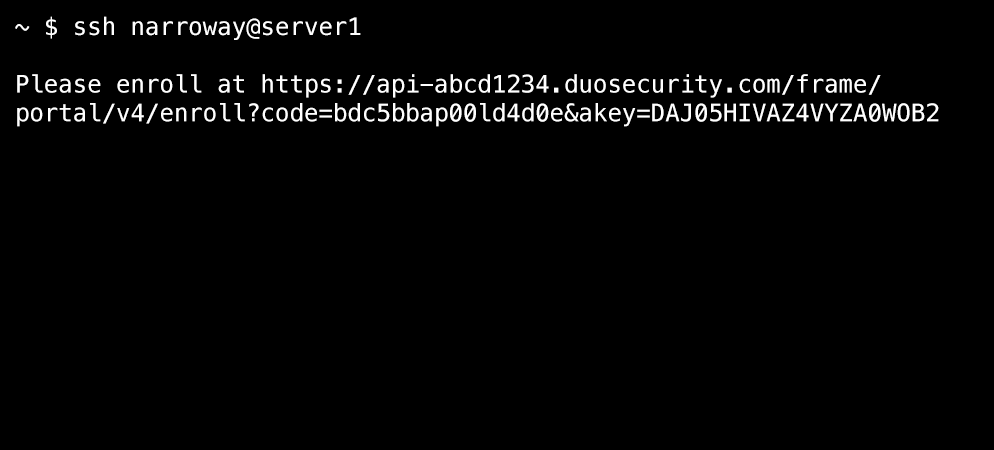
Copy the enrollment link and paste it into a web browser to complete Duo's enrollment process.
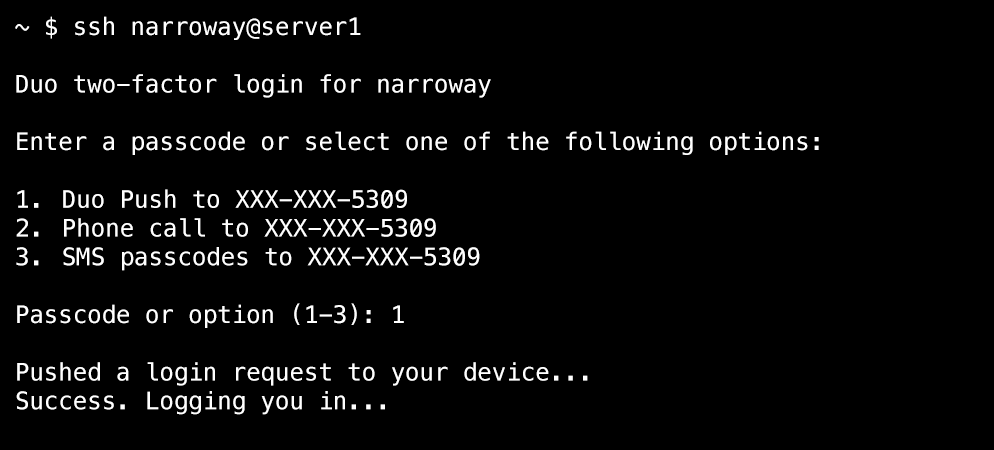
After enrolling your authentication device with Duo (or if your test user was already enrolled in Duo), you'll receive the prompt for additional verification. Choose your authentication method and approve the request using your phone or other device.
In this example, Duo Push was selected and the effective authentication methods policy did not require Verified Duo Push. Login access was granted after approving the Duo Push request from the selected device.
In the following example, Duo Push was selected and the effective authentication methods policy required Verified Duo Push with a verification code. Login access was granted after entering the verification code shown into Duo Mobile on the selected device in response to the Duo Push request.
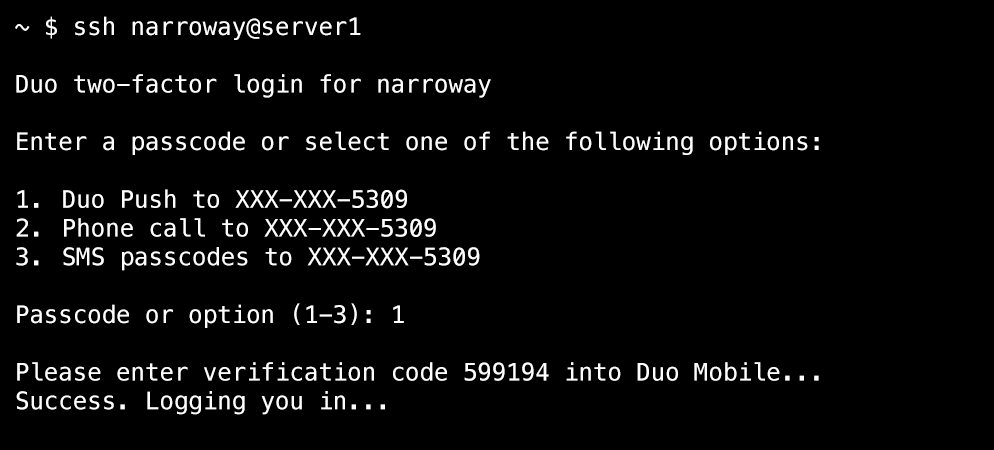
Learn more about completing Verified Duo Push authentication on Android or iOS/iPadOS.
Troubleshooting
Need some help? Take a look at the Duo UNIX Frequently Asked Questions (FAQ) page or try searching our Duo UNIX Knowledge Base articles or Community discussions. For further assistance, contact Support.
If you open a support case with Duo, be sure to use the Duo Unix Support Tool to create a tarball you can send to the support engineer to aid with troubleshooting.
Uninstall Duo
To remove Duo Unix (pam_duo) from your system, reverse the PAM or SSH configuration changes you made during installation, then uninstall the Duo package using your system's package manager (duo-unix on Debian/Ubuntu or duo_unix on RPM-based systems), or run sudo make uninstall if you installed from source.
Do not delete the Duo Unix application from the Duo Admin Panel until you have uninstalled the Duo application from all systems using that application. If you delete the Admin Panel application before uninstalling the Duo software, users may be unable to log in to those systems.
Network Diagram
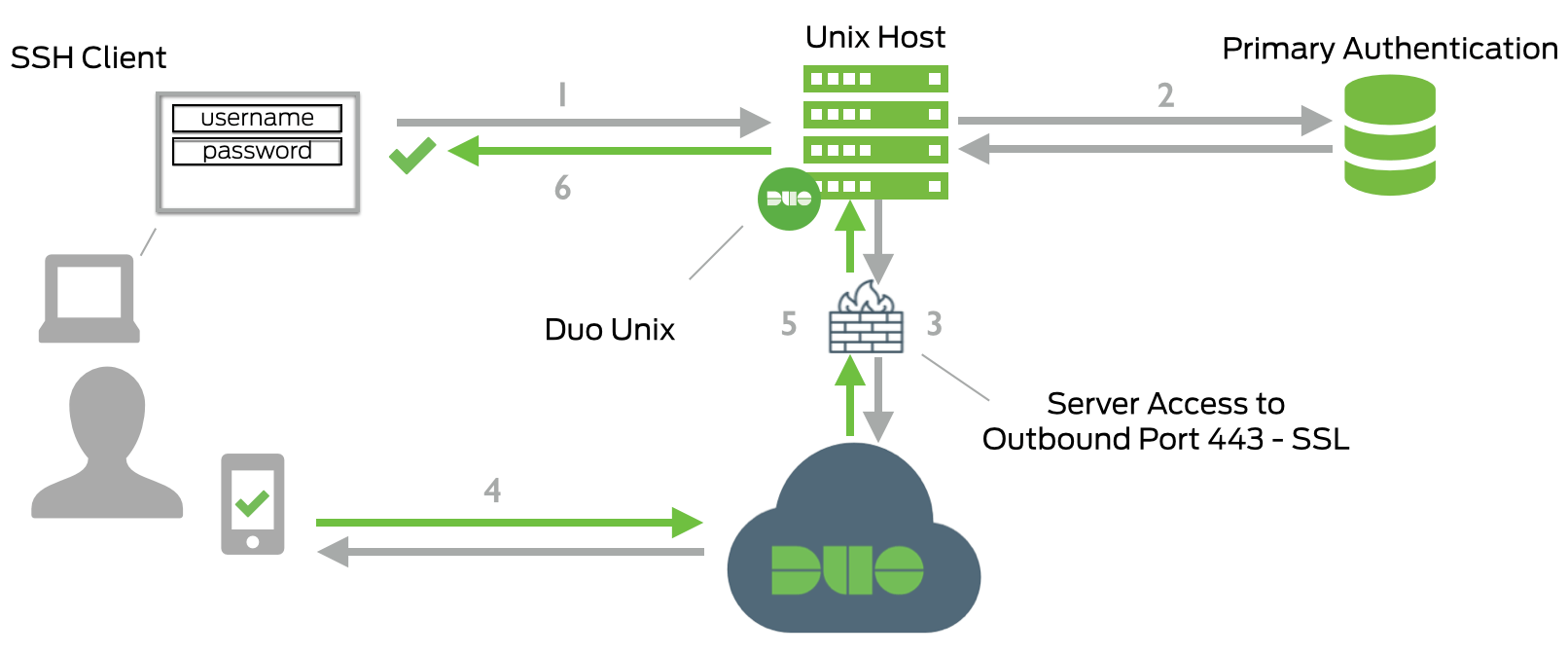
- SSH connection initiated
- Primary authentication
- Duo Unix connection established to Duo Security over TCP port 443
- Secondary authentication via Duo Security’s service
- Duo Unix receives authentication response
- SSH session logged in